
10 Signs Your Child Needs Extra Academic Support
Satyam Kumar Singh From Remedial-one Educational desk.
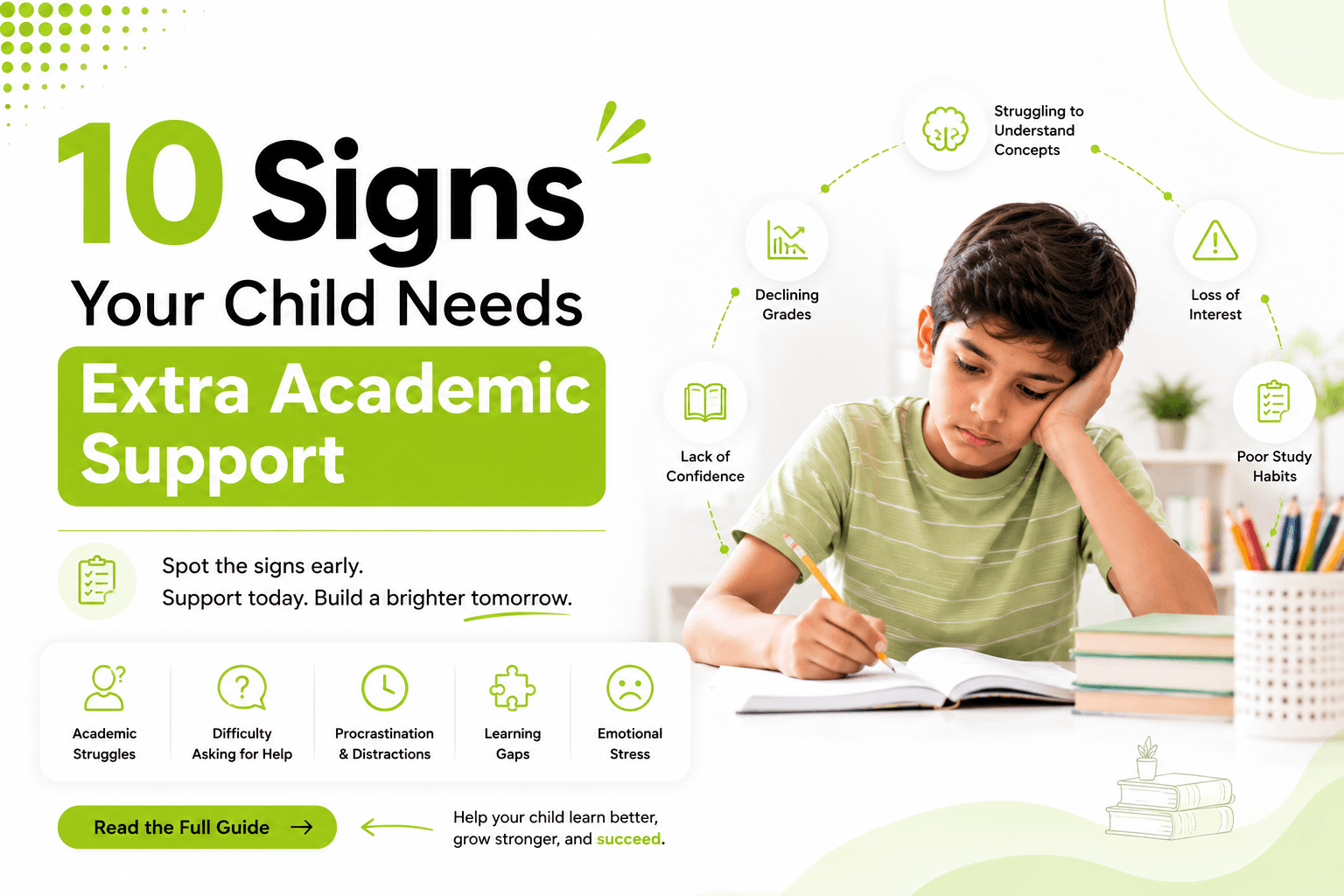
10 Signs Your Child Needs Extra Academic Support
Children do not always tell parents when they are struggling academically. Sometimes the signs appear through falling grades, unfinished homework, frustration, or a sudden loss of confidence.
One poor test result does not necessarily mean a child needs extra help. However, when difficulties continue over time, it may be worth looking more closely at what is causing them.
If you are wondering whether your child needs extra academic support, this guide will help you identify 10 common signs and understand what you can do next.
1. Your Child's Grades Are Consistently Falling
A single low mark is not usually a reason for concern. But a consistent decline in grades can indicate that your child is having difficulty understanding important concepts.
Pay attention if your child:
Struggles across several tests
Finds previously easy subjects difficult
Makes the same mistakes repeatedly
Falls behind as lessons become more advanced
The key is to look for a pattern rather than focusing on one result.
2. Homework Takes Much Longer Than Expected
Does a normal homework assignment regularly take your child several hours?
Taking extra time occasionally is normal, particularly when the subject is difficult. But consistently spending much longer than expected may indicate a learning gap or difficulty understanding instructions.
Instead of assuming your child is not working hard enough, find out where they are getting stuck.
Are they struggling to understand the question? Do they forget basic concepts? Are they unable to start without your help?
These details can reveal what type of academic support may be needed.
3. Your Child Regularly Avoids Studying
Some resistance to homework is completely normal. Persistent avoidance, however, can sometimes be a sign that learning has become frustrating.
A child may avoid studying because they expect to make mistakes or do not know how to approach the work.
Try asking:
"Which part of this subject feels difficult?"
This can be more useful than simply asking why they do not want to study.
Understanding the reason behind avoidance can help parents address the actual problem rather than treating it as laziness.
4. The Same Mistakes Keep Happening
Mistakes are an essential part of learning. The concern arises when a child repeatedly makes the same mistake even after it has been explained.
For example, your child may repeatedly:
Use the wrong mathematical operation
Confuse grammar rules
Misunderstand word problems
Forget basic formulas
Misinterpret instructions
This may indicate that the underlying concept has not been fully understood.
Instead of simply giving more questions to practise, your child may need the concept explained in a different way.
5. Your Child Struggles to Keep Up With the Class
Every student learns at a different pace. Some children need additional time and practice before they feel comfortable with a new topic.
If your child regularly says they cannot understand what is being taught or struggles to complete classroom work, it is worth paying attention.
This does not automatically mean your child has a learning disorder or lacks ability. They may simply have missed an important foundation or need more individual attention.
Targeted academic support can help identify where the difficulty begins and work from that point.
6. Your Child Has Lost Academic Confidence
Academic difficulties can affect a child's confidence.
Statements such as:
"I'm bad at maths."
"I can't do this."
"I'm not good at school."
"I'll never get good marks."
should not simply be dismissed.
Repeated difficulty can create a cycle:
Struggle → mistakes → frustration → low confidence → avoidance → less practice.
The goal of extra academic support should therefore be more than improving marks. It should also help students understand what they can do, identify what needs improvement, and experience steady progress.
7. Studying Causes Frequent Frustration
Notice how your child reacts when they encounter a difficult question.
Do they keep trying, or do they immediately become upset, shut their book, or refuse to continue?
Frequent frustration can indicate that the current learning approach is not working for them.
This is especially useful to observe when frustration is linked to a particular subject. A child who enjoys reading but becomes extremely frustrated during mathematics homework may need more focused support in mathematics rather than additional study time across every subject.
The objective is not to remove difficult work. Children need challenges to develop problem-solving skills. The challenge should simply be appropriate and manageable.
8. Your Child Needs Help With Almost Every Homework Task
Helping with homework is normal. However, if your child consistently needs an adult beside them to explain every question or instruction, it may be worth understanding why.
Ask yourself:
"Does my child need occasional guidance, or are they unable to work independently?"
Effective academic support should gradually encourage independence.
Students should learn how to understand instructions, apply concepts, check their answers, and approach unfamiliar questions—not simply wait for someone else to provide the answer.
9. Your Child Works Hard but Still Struggles
Not every academic problem comes from a lack of effort.
Some students spend hours studying but continue to struggle because their study method does not address the actual learning gap.
For example, a student may:
Memorise without understanding
Practise questions without correcting the underlying mistake
Spend too much time on topics they already know
Revise without a clear plan
In such cases, simply increasing study hours may not solve the problem.
A more personalised approach can identify what the student understands, where the gap begins, and which concepts should be prioritised.
10. Your Child's Attitude Toward School Has Changed
A sudden change in your child's attitude toward school deserves attention.
Perhaps they previously enjoyed learning but now complain frequently. Maybe they have stopped participating in class or no longer want to discuss school.
Academic difficulty can be one reason, but it is not the only possibility. Changes in friendships, stress, workload, sleep, or other circumstances can also affect a child's behaviour.
Talk to your child and, where appropriate, communicate with their teacher before reaching conclusions.
Does One Sign Mean My Child Needs Extra Academic Support?
Not necessarily.
One difficult test, one unfinished assignment, or one frustrating evening does not automatically mean a child needs additional tutoring.
Look for persistent patterns that affect learning, confidence, independence, or school participation.
Extra support may be worth considering when:
Difficulties continue despite regular effort
Learning gaps appear to be increasing
Your child consistently falls behind
Homework creates frequent frustration
Confidence has noticeably decreased
Performance does not match the effort being made
The purpose should be to understand and address the learning need—not simply to increase study hours.
What Can Parents Do If They Notice These Signs?
Start by identifying the problem.
Talk to your child
Ask what they find difficult and listen without comparing them with other children.
Speak with the teacher
Teachers can provide valuable insight into classroom participation, assignments, understanding, and progress.
Identify the specific learning gap
Instead of saying "My child is weak in maths," try to identify the exact difficulty. Is it fractions, algebra, calculations, word problems, or something else?
Focus on the foundation
If a child has missed an important concept, revisiting the foundation may be more useful than immediately moving to advanced material.
Consider personalised support
Some students benefit from individual attention where explanations, practice, feedback, and pace can be adjusted to their specific needs.
RemedialOne focuses on personalised learning and one-to-one academic support, which can be relevant for students who need more individual attention in their learning journey.
Extra Academic Support vs. Studying More
More study time is not always better.
| Approach | Potential benefit |
|---|---|
| Self-study | Builds independent learning habits |
| Group tuition | Provides structured teaching and practice |
| One-to-one support | Allows more personalised attention |
| Parent-led homework help | Provides immediate guidance |
The right option depends on the child's age, subject, learning gaps, confidence, and existing support system.
The goal should be better learning, not simply longer study hours.
Frequently Asked Questions
What are the signs that a child needs extra academic support?
Common signs include consistently falling grades, homework difficulties, repeated mistakes, study avoidance, low confidence, frequent frustration, and difficulty keeping up with classroom learning.
Does poor academic performance always mean a child needs tutoring?
No. Academic performance can be affected by many factors. Parents should look for persistent difficulties and try to understand the underlying reason before choosing a support option.
Should I make my child study longer if they are struggling?
Not necessarily. If the underlying learning gap has not been identified, additional study hours may increase frustration. A focused approach can be more useful.
Can one-to-one tutoring help a struggling student?
One-to-one tutoring provides individual attention and can allow teaching to focus on a student's specific needs. Its effectiveness depends on the student's requirements and the quality of the learning approach.
When should parents talk to a teacher?
Parents should consider speaking with a teacher when academic difficulties continue, grades decline, homework becomes difficult, or there is a noticeable change in classroom participation or confidence.
Conclusion
Recognising that your child is struggling is not a reason to panic. It is an opportunity to understand what they need.
The most important thing is to look beyond marks and notice patterns in homework, confidence, mistakes, classroom participation, and attitude toward learning.
If your child needs more individual attention than their current learning environment provides, personalised academic support may be worth exploring. RemedialOne's one-to-one learning approach can be considered as one option for families looking for more individualised academic guidance.
The right support is not about putting pressure on a child to study more. It is about helping them understand better, strengthen their foundations, build confidence, and gradually become a more independent learner.