
Best Online One-to-One Tuition Classes: A Complete Guide for Students and Parents
Aditya Singh Remedial one Desk
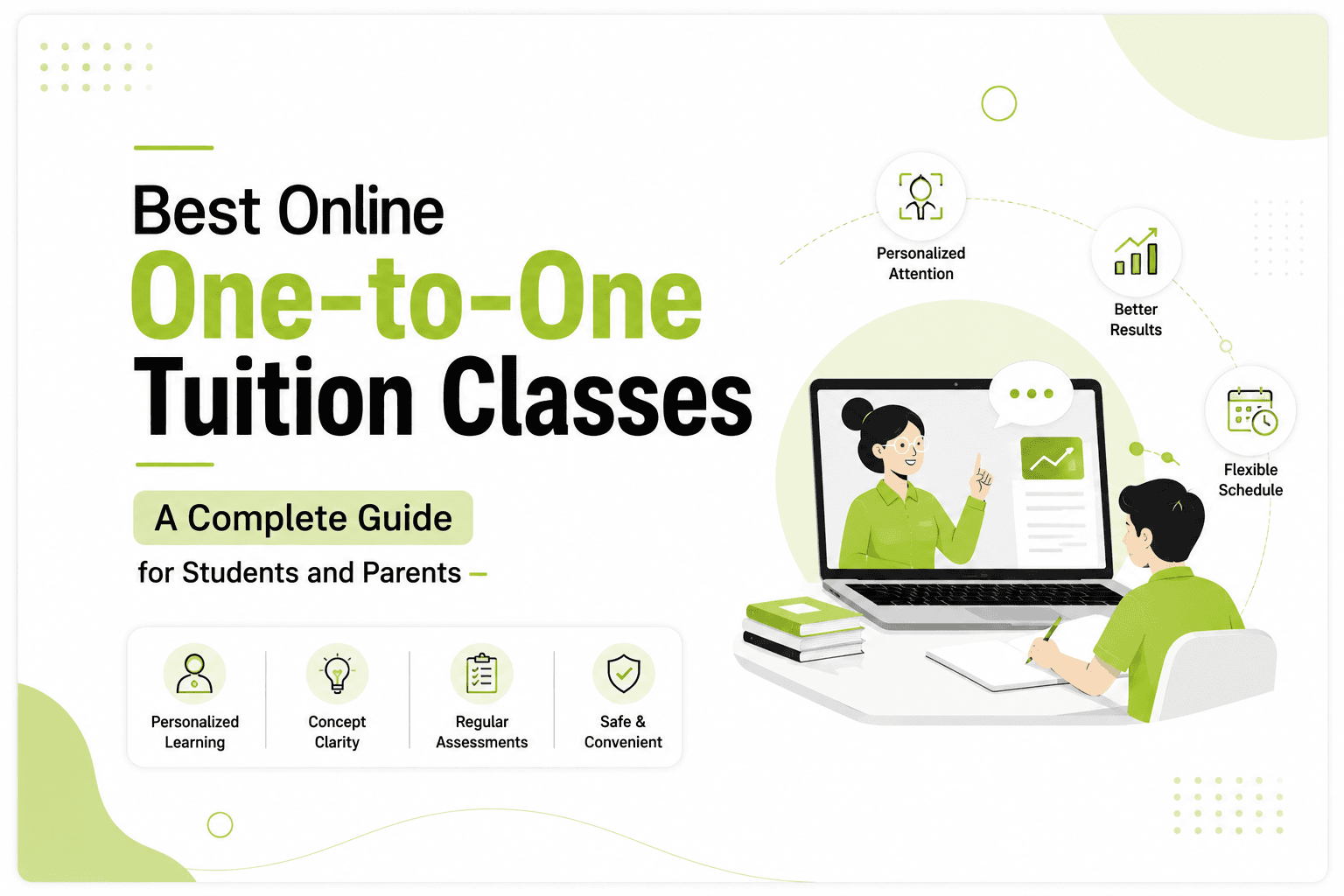
Best Online One-to-One Tuition Classes: A Complete Guide for Students and Parents
Introduction
Finding the right online one-to-one tuition classes can make a significant difference when a student needs more personalised academic support.
In a regular classroom, teachers generally have to follow a common pace. Some students understand a concept quickly, while others may need additional explanation, examples, practice, or time. One-to-one online tuition takes a different approach: the teacher can focus entirely on one student and adjust the lesson according to their current understanding.
But with so many online tutoring options available, how do you decide which one is actually suitable?
The answer isn't simply to choose the tutor with the highest qualification or the lowest fee. Parents and students should consider the tutor's teaching approach, subject expertise, class structure, assessment process, flexibility, progress tracking, and ability to provide personalised support.
This guide explains what to look for when choosing the best online one-to-one tuition classes and how to determine whether they are right for your child's learning needs.
What Are Online One-to-One Tuition Classes?
Online one-to-one tuition is a personalised learning format where one student attends a live class with one tutor through an online platform.
Unlike group tuition, the entire session is focused on one student's academic requirements.
The tutor can adjust:
The pace of teaching
Difficulty level
Explanation style
Practice questions
Revision schedule
Homework
Learning objectives
For example, if a student understands algebra but struggles with fractions, the tutor can spend more time strengthening the relevant foundational concepts instead of moving through the entire syllabus at the same pace as a group.
This makes one-to-one tuition particularly useful for students who need targeted academic support.
Why Do Students Choose One-to-One Online Tuition?
One of the biggest advantages is individual attention.
In a group class, a student may hesitate to ask repeated questions or may not receive enough time to explain where they are struggling. In a one-to-one class, the tutor can immediately identify confusion and work through it.
Personalised Learning Pace
Every student learns at a different speed.
A tutor can slow down when a concept is difficult and move forward when the student demonstrates understanding.
Individualised Explanations
If one explanation doesn't work, the tutor can try another approach.
A mathematical concept, for example, can be explained using examples, diagrams, step-by-step calculations, or practical applications.
More Opportunity to Ask Questions
Students can ask questions throughout the session without worrying about interrupting a group class.
Focused Practice
Instead of spending an entire session on concepts the student already knows, the tutor can concentrate on areas that require improvement.
Flexible Learning
Online classes can be more convenient for students and parents because they eliminate the need to travel to a tuition centre.
Who Can Benefit From Online One-to-One Tuition?
One-to-one tuition isn't only for students who are performing poorly.
It can benefit students with different academic goals.
Students With Learning Gaps
A student may have difficulty with a current topic because they haven't fully understood an earlier concept.
Personalised tutoring can help identify these gaps and work on them systematically.
Students Preparing for Exams
Students preparing for school examinations or other academic assessments may benefit from focused revision, question practice, and individual feedback.
Students Who Need Extra Practice
Some students understand concepts during class but need additional guided practice before they can solve questions independently.
High-Performing Students
One-to-one tuition can also be useful for students who want to explore more challenging questions or strengthen specific subjects.
Students Who Prefer Individual Attention
Some children simply learn better when they can interact directly with their tutor rather than learning in a group environment.
What Should You Look for in the Best Online One-to-One Tuition Classes?
Not every online tutoring service provides the same learning experience.
Before choosing a program, evaluate several important factors.
1. Qualified and Relevant Tutors
Check whether the tutor has relevant subject knowledge and experience teaching the student's academic level.
A tutor who is excellent at teaching university-level mathematics may not necessarily be the right fit for a primary-school student.
Look for experience with:
Your child's class
Your child's curriculum
The relevant subject
The student's academic goals
2. Initial Assessment
A good tutoring program should ideally understand the student's current level before creating a learning plan.
An assessment can help identify:
Strong areas
Weak areas
Foundational gaps
Conceptual difficulties
Problem-solving ability
Topics requiring additional practice
This prevents tutoring from becoming a generic repetition of the school syllabus.
3. Personalised Lesson Plans
The tutor should have a clear understanding of what the student needs to work on.
A personalised lesson plan may include:
Identifying the learning gap
Explaining the underlying concept
Practising guided questions
Testing independent understanding
Revising difficult areas
Moving to more advanced applications
4. Interactive Classes
Online tuition should not simply involve a tutor speaking while the student watches.
Look for sessions where the student is encouraged to:
Ask questions
Solve problems
Explain their reasoning
Participate in discussions
Complete practice exercises
Receive immediate feedback
Active participation is particularly important in subjects such as mathematics and science.
5. Regular Progress Tracking
Parents should know whether the student is actually improving.
Ask how the tutoring program measures progress.
Useful indicators can include:
Concept mastery
Accuracy
Independent problem-solving
Completion of assignments
Performance in assessments
Ability to apply concepts to unfamiliar questions
Online One-to-One Tuition vs Group Tuition
Both formats can be useful, but they provide different learning experiences.
| Factor | One-to-One Tuition | Group Tuition |
|---|---|---|
| Individual Attention | Very High | Limited |
| Learning Pace | Personalised | Common pace |
| Questions | Unlimited opportunity | Limited by class time |
| Lesson Plan | Student-specific | Usually common |
| Progress Tracking | Individual | Often general |
| Flexibility | High | Usually scheduled |
| Peer Interaction | Limited | Higher |
| Suitable for Learning Gaps | Strong fit | Depends on the class |
| Cost | Usually higher | Usually lower |
If a student needs targeted support, individual attention may provide a better fit.
If the student is comfortable learning at a common pace and enjoys peer interaction, group tuition may be sufficient.
How Much Do Online One-to-One Tuition Classes Cost?
The cost of online tutoring can vary significantly.
Factors that may influence pricing include:
Subject
Class level
Tutor experience
Session duration
Number of sessions
Exam preparation requirements
Individual versus group format
Additional assessment or learning resources
Parents should therefore avoid comparing tutoring programs only on the basis of price.
Instead, ask:
What does the fee include?
For example:
Initial assessment
Personalised lesson planning
Live classes
Study material
Assignments
Progress reports
Parent feedback
Doubt-solving support
A lower fee may not provide the level of individualisation a student needs, while a higher fee doesn't automatically mean better teaching.
The goal should be to find the right balance between quality, personalisation, consistency, and affordability.
How Should Parents Evaluate an Online Tutor?
A trial or introductory session can be extremely useful.
During the session, observe how the tutor interacts with the student.
Does the Tutor Ask Questions?
A good tutor should regularly check whether the student understands the concept.
Does the Tutor Encourage the Student?
Students should feel comfortable making mistakes and asking questions.
Does the Tutor Explain the Reasoning?
Simply giving the correct answer isn't enough.
The student should understand how to reach the answer independently.
Does the Tutor Adapt?
If the student doesn't understand the first explanation, does the tutor try a different approach?
Does the Student Participate?
The session should involve the student rather than becoming a one-way lecture.
What Questions Should You Ask Before Enrolling?
Parents can ask the tutoring provider or tutor:
Which classes and curricula do you teach?
How do you assess a student's current level?
How do you identify learning gaps?
Is the lesson plan personalised?
How frequently is progress assessed?
How do parents receive progress updates?
What happens if my child doesn't understand a topic?
Are practice materials provided?
How long is each session?
Is there a trial class?
What happens if a student misses a class?
What support is available outside the live session?
Clear answers to these questions can help you understand what you're actually paying for.
What Makes One-to-One Tuition Different From Regular Online Classes?
The main difference is the level of personalisation.
A regular online class may still provide excellent teaching, but the tutor has to divide attention between multiple students.
In a one-to-one environment, the entire session can revolve around one student's needs.
For example, imagine a student has difficulty solving word problems.
In a group class, the teacher may explain the topic once and then continue with the lesson.
In a one-to-one class, the tutor can:
Identify where the student gets confused.
Break the question into smaller parts.
Explain how to identify relevant information.
Work through an example.
Give the student a similar question.
Observe the student's method.
Correct the misunderstanding.
Gradually increase the difficulty.
That level of individual attention is the primary reason parents choose one-to-one tutoring.
How Can You Tell Whether the Tuition Is Working?
Don't judge progress only by examination marks.
Marks are important, but they are only one indicator.
Look for changes in the student's learning behaviour.
Your child may be making progress if they:
Ask more questions
Make fewer repeated mistakes
Complete assignments more independently
Explain concepts in their own words
Solve unfamiliar problems
Need less assistance
Become more confident with difficult topics
Show greater consistency in schoolwork
Parents should also request specific feedback from the tutor.
Instead of asking, "Is my child improving?", ask:
"Which concepts can my child now solve independently, and which areas still require support?"
This gives you a much clearer picture of progress.
Common Mistakes Parents Should Avoid
Choosing Only Based on Price
Affordable tuition can be valuable, but the cheapest option isn't necessarily the most suitable.
Choosing Only Based on Tutor Qualifications
Qualifications matter, but teaching ability and relevant experience matter too.
Skipping the Assessment
Without understanding the student's current level, it can be difficult to create targeted lessons.
Expecting Immediate Results
Learning takes time. Progress depends on the student's starting level, consistency, teaching quality, and the nature of the academic challenge.
Giving the Tutor Complete Responsibility
A tutor can provide instruction and guidance, but students still need to attend regularly, practise and participate.
Not Reviewing Progress
Parents should periodically check whether the tutoring approach is addressing the original problem.
How to Choose the Best Online One-to-One Tuition Classes
Before making a decision, create a simple checklist.
Step 1: Identify the Problem
Determine whether your child needs:
Concept clarification
Foundational support
Homework assistance
Exam preparation
Subject improvement
Advanced practice
Step 2: Understand the Current Level
Review recent schoolwork, tests and assignments. If necessary, consider a structured learning assessment.
Step 3: Shortlist Suitable Tutors
Look for tutors who have experience with your child's class, curriculum and subject.
Step 4: Attend a Trial Session
Observe the teaching style and your child's response.
Step 5: Ask About Progress Tracking
Understand how improvement will be measured and communicated.
Step 6: Compare Overall Value
Consider teaching quality, personalisation, resources, flexibility and support—not just the fee.
Step 7: Review After a Few Weeks
Evaluate whether your child's understanding, confidence and independent problem-solving are improving.
Frequently Asked Questions
Are online one-to-one tuition classes effective?
They can be effective when the tutor's teaching approach matches the student's needs and the student participates consistently. Individual attention allows lessons to be adapted to the student's pace and areas of difficulty.
Is one-to-one tuition better than group tuition?
It depends on the student. One-to-one tuition provides more individual attention and personalisation, while group tuition can offer peer interaction and may be more affordable.
Which students need one-to-one tuition?
Students with specific learning gaps, students who need additional explanation, students preparing for examinations, and students who prefer individual attention may benefit from one-to-one tuition.
How should I choose an online tutor for my child?
Consider the tutor's relevant teaching experience, subject expertise, teaching style, assessment process, availability, progress tracking and ability to personalise lessons.
How long should an online tuition class be?
There is no universal ideal duration. It depends on the student's age, subject, attention span and learning requirements. Consistent, focused sessions are generally more useful than simply making classes longer.
How can parents track the effectiveness of online tuition?
Parents can review changes in conceptual understanding, independent problem-solving, repeated mistakes, assignment performance, confidence and assessment results.
Final Verdict
The best online one-to-one tuition classes are not necessarily the ones with the most advertisements, the lowest fees or the longest list of features.
The better choice is the one that understands the student's actual learning needs and provides appropriate individual support.
Before enrolling, look for five things:
Assessment: Does the program understand the student's current level?
Personalisation: Are lessons adapted to the student's needs?
Quality Teaching: Can the tutor explain concepts clearly?
Progress Tracking: Can parents see whether the student is improving?
Consistency: Does the student receive regular opportunities to practise and apply what they learn?
One-to-one tutoring can be particularly valuable when a student has specific learning gaps or needs a learning pace different from that of a regular classroom.
The objective should not simply be to complete more worksheets or finish the syllabus faster. The real goal is to help the student understand concepts, develop independent problem-solving skills and become more confident in their learning.
If you're considering personalised academic support for your child, start by identifying what they are struggling with and why. Once that is clear, choosing the right online one-to-one tuition format becomes much easier.
Need Personalised Academic Support?
If your child needs individual attention or you're unsure about the specific areas where they need support, RemedialOne can help you explore a more personalised approach to learning.
The right support starts with understanding the learner—not simply giving them more work.