
How Personalized Learning Helps Students Improve Faster
Aditya From Remedial-one Desk
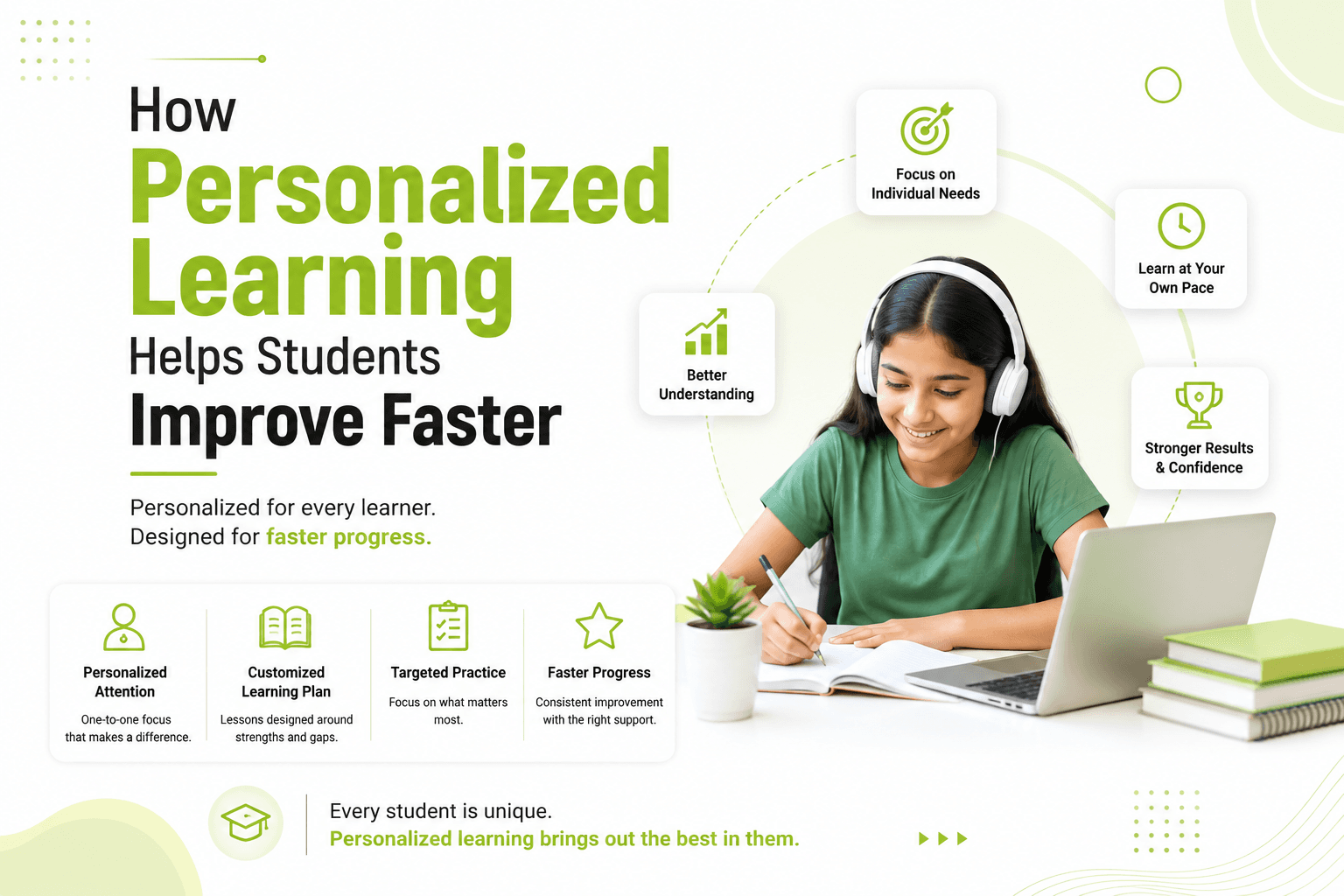
How Personalized Learning Helps Students Improve Faster
Introduction
Not every student learns in the same way or at the same pace. A concept that takes one student ten minutes to understand may require several explanations and examples for another. This is one of the biggest limitations of a standard, one-size-fits-all approach to education.
Personalized learning addresses this problem by adapting the learning experience to the individual student. Instead of expecting every learner to follow the same pace, teaching can be adjusted according to the student's current level, strengths, weaknesses, learning gaps, and academic goals.
But does personalized learning actually help students improve faster?
In many situations, it can—because students spend more time working on what they actually need to learn instead of repeatedly studying concepts they already understand.
This guide explains how personalized learning works, why it can accelerate academic progress, and what parents and students should look for when choosing personalized academic support.
What Is Personalized Learning?
Personalized learning is an approach where teaching is adapted to the individual needs of a student.
Instead of following exactly the same learning path for every student, the approach considers factors such as:
Current academic level
Existing knowledge
Learning gaps
Strengths and weaknesses
Learning pace
Subject-specific difficulties
Academic goals
Progress over time
For example, imagine two students studying algebra.
Student A understands basic equations but needs more practice with word problems.
Student B is still struggling with basic arithmetic operations.
Giving both students the exact same lesson may not be the most effective approach.
Personalized learning allows the teacher to focus on the specific skills each student needs to strengthen.
Why Does Personalized Learning Help Students Improve Faster?
The main advantage is targeted learning.
Students don't necessarily improve faster simply because they study for more hours. They can often make better progress when their learning time is focused on the right concepts.
1. It Identifies Learning Gaps
One of the first steps in personalized learning is understanding what the student already knows.
A student may appear to struggle with a particular topic when the real problem is an earlier concept.
For example, a student having difficulty with fractions may actually have trouble with multiplication or division.
If the underlying gap isn't addressed, simply practising fractions may not solve the problem.
Personalized learning helps identify these gaps so teaching can begin at the appropriate level.
2. Students Learn at Their Own Pace
In a traditional classroom, teachers have to work within a fixed schedule.
A student who understands a topic quickly may become bored, while another student may still be confused when the class moves forward.
Personalized learning allows the pace to change according to the learner.
If a concept is difficult, the teacher can spend more time explaining it.
If the student has already mastered a topic, the lesson can move forward instead of spending unnecessary time repeating it.
This can make learning more efficient.
3. Teaching Can Be Adapted to the Student
Different students may respond to different explanations.
One student may understand mathematics through worked examples. Another may need diagrams or step-by-step explanations.
A personalized approach allows the tutor or teacher to adjust the method.
For example, a difficult science concept might be explained through:
A simple real-world example
A diagram
A step-by-step explanation
Practice questions
A discussion with the student
The objective is not to teach the topic in one fixed way. It is to find an explanation that helps the student understand it.
4. Students Get More Individual Attention
Personalized learning is particularly useful when a student needs focused support.
In a group classroom, a teacher has to divide attention among multiple students.
A student may have a question but hesitate to ask it. Another may make a mistake without receiving immediate feedback.
With individual support, the teacher can observe the student's approach and identify where they are getting stuck.
This makes it easier to correct misunderstandings before they become repeated mistakes.
For students who benefit from individual academic support, personalized learning can provide a more focused learning structure.
5. It Focuses on Understanding, Not Just Memorization
A student can sometimes memorize a formula, definition, or answer without truly understanding the concept.
Personalized teaching gives the tutor more opportunity to check whether the student can actually apply what they have learned.
For example, instead of asking only:
"Do you know this formula?"
the tutor can ask:
"Can you explain when you would use this formula?"
The student can then solve a new question using the same concept.
This helps distinguish memorization from genuine understanding.
6. Students Receive Immediate Feedback
Feedback is an important part of learning.
When a student makes a mistake, understanding the reason behind that mistake can be more useful than simply seeing the correct answer.
A personalized tutor can identify whether the issue is:
A conceptual misunderstanding
A calculation error
A reading mistake
Incorrect application of a formula
Lack of practice
Confusion between similar concepts
Once the reason is clear, the student can work on the specific problem.
7. It Builds Confidence Through Small Improvements
Repeatedly struggling with a subject can affect a student's confidence.
A child may begin thinking:
"I'm just not good at maths."
But sometimes the problem isn't ability. The student may simply have missed an important foundation.
Personalized learning can break a larger problem into smaller, achievable steps.
For example:
Understand multiplication → practise fractions → understand fraction operations → solve word problems
Each improvement gives the student evidence that they can learn the concept.
Over time, this can help build confidence and encourage students to participate more actively.
8. Learning Goals Become More Specific
A broad goal such as "improve mathematics" doesn't tell a student what they actually need to do.
Personalized learning can turn it into smaller objectives.
For example:
Improve multiplication accuracy
Understand fractions
Solve linear equations
Interpret mathematical word problems
Reduce calculation errors
Specific goals make it easier for both the student and tutor to track progress.
9. Progress Can Be Monitored Regularly
Personalized learning isn't a one-time adjustment.
The student's performance should be reviewed regularly.
A tutor can compare the student's current performance with earlier work and determine whether a particular concept has improved.
Progress can be evaluated through:
Practice questions
Assignments
Topic-based assessments
Classroom performance
Independent problem-solving
Ability to explain concepts
This helps determine whether the current learning strategy is working or needs to be changed.
Personalized Learning vs Traditional Classroom Learning
Both approaches can play an important role in education, but they work differently.
| Factor | Personalized Learning | Traditional Classroom |
|---|---|---|
| Learning Pace | Adapted to the student | Common class pace |
| Individual Attention | High | Limited |
| Lesson Plan | Student-specific | Usually common |
| Learning Gaps | Can be specifically targeted | May receive less individual attention |
| Feedback | More immediate | Depends on class size |
| Practice | Based on student needs | Often standardised |
| Flexibility | Higher | More structured |
| Peer Interaction | Depends on format | High |
Personalized learning doesn't necessarily need to replace classroom education.
It can complement school learning by providing additional support where a student needs it.
Who Can Benefit From Personalized Learning?
Personalized learning can be useful for students with different academic needs.
Students With Learning Gaps
Students who have missed foundational concepts may benefit from targeted instruction.
Students Struggling With a Particular Subject
A student may perform well overall but need additional support in mathematics, science, English, or another subject.
Students Preparing for Exams
Personalized lessons can focus on areas that require revision and additional practice.
Students Who Learn Quickly
Advanced students can move beyond basic material and work on more challenging concepts.
Students Who Need Additional Confidence
Individual support can provide a less pressured environment for students who hesitate to participate in larger classes.
How Can Parents Make Personalized Learning More Effective?
Parents also have an important role.
Understand the Actual Problem
Don't assume that low marks automatically mean the child needs more tuition.
Try to understand whether the issue is conceptual understanding, practice, concentration, foundational knowledge, or something else.
Set Realistic Goals
Focus on specific skills instead of expecting immediate improvement in every subject.
Encourage Questions
Children should feel comfortable saying when they don't understand something.
Review Progress
Ask the tutor specific questions about what the child has improved and what still needs attention.
Give the Process Time
Personalized learning can make learning more targeted, but progress still depends on consistency, student participation, and the complexity of the learning challenge.
Common Mistakes to Avoid
Mistake 1: Assuming Personalized Means Easy
Personalized learning isn't about reducing academic expectations. It is about providing the appropriate level of challenge and support.
Mistake 2: Focusing Only on Marks
Marks are useful, but understanding and independent application are also important indicators of progress.
Mistake 3: Changing Tutors Too Quickly
Students may need time to become comfortable with a teaching approach and build consistency.
Mistake 4: Giving Too Much Practice
More work isn't always better. Practice should target the skills the student actually needs.
Mistake 5: Not Tracking Progress
Without regular review, it becomes difficult to know whether the learning strategy is addressing the original problem.
How Does Personalized Learning Help Students Improve Faster?
The process can be simplified into five stages:
1. Assess → Understand the student's current level.
2. Identify → Find specific strengths and learning gaps.
3. Personalize → Create lessons based on the student's needs.
4. Practise → Apply concepts through guided and independent practice.
5. Review → Measure progress and adjust the learning plan.
This creates a learning cycle rather than a fixed teaching method.
If a student continues to struggle, the approach can be adjusted instead of simply repeating the same lesson.
Frequently Asked Questions
What is personalized learning?
Personalized learning is an educational approach where teaching, pace, practice, and learning goals are adapted to an individual student's needs and current level.
Does personalized learning help students improve faster?
It can help students learn more efficiently by focusing instruction on their specific learning needs, addressing gaps, and avoiding unnecessary repetition. However, progress varies between students.
Is personalized learning suitable for weak students only?
No. It can benefit students at different academic levels. Students who are already performing well can also use personalized learning to work on advanced concepts or specific academic goals.
Can personalized learning help with learning gaps?
Yes. One of its key benefits is the ability to identify and target specific gaps in foundational knowledge or subject understanding.
Is one-to-one tutoring the same as personalized learning?
Not exactly. One-to-one tutoring is a learning format, while personalized learning is an approach to teaching. One-to-one tutoring can make personalization easier because the tutor can focus entirely on one student's needs.
How long does personalized learning take to show results?
There is no fixed timeline. Progress depends on the student's starting level, the nature of the learning gaps, consistency, teaching approach, and the student's participation.
Final Verdict
Personalized learning can help students improve more efficiently because it shifts the focus from teaching everyone the same way to understanding what each student actually needs.
Instead of simply giving more homework or repeating the same lessons, personalized learning can identify learning gaps, adjust the pace, provide individual explanations, give immediate feedback, and track progress over time.
The most important benefit isn't necessarily learning faster in terms of completing more chapters. It is making learning more focused and meaningful.
For parents, the right question is therefore not simply:
"How many hours should my child study?"
A better question is:
"Is my child spending those hours learning the concepts they actually need to improve?"
When assessment, personalised teaching, consistent practice, and progress tracking work together, students have a clearer path toward stronger understanding and greater academic confidence.
If your child is struggling with specific concepts or you aren't sure where their learning gaps are, starting with an appropriate assessment can help identify what kind of support they actually need.
:::