
How to Choose a Math Tutor in Noida: A Complete Guide for Parents
I’m Nihal, the Editorial Head at Remedial-one Team. I lead our content team and focus on creating clear, reliable, and engaging content that helps students make better education and career decisions.
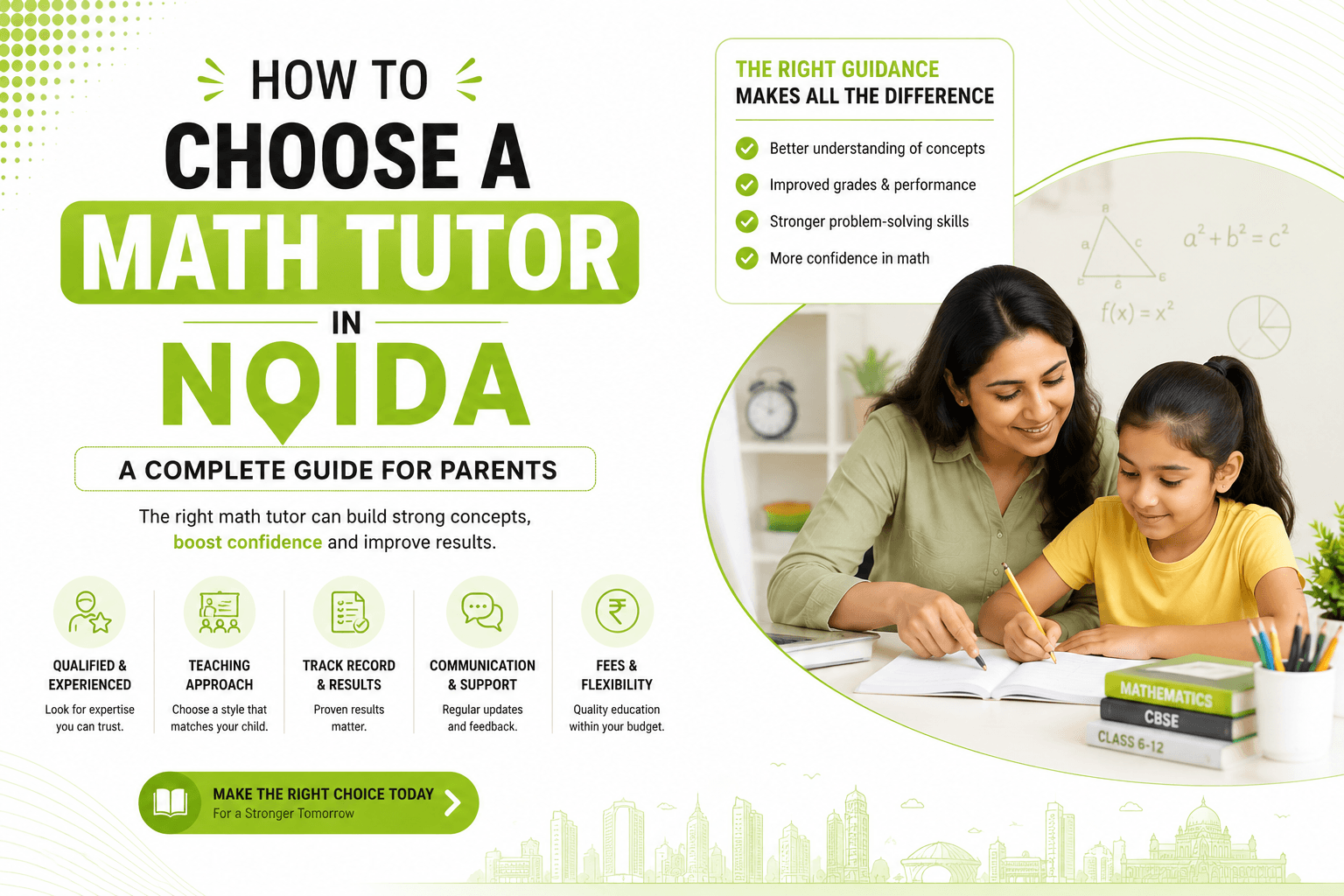
How to Choose a Math Tutor in Noida: A Complete Guide for Parents
Introduction
Finding the right math tutor in Noida can be difficult, especially when your child is struggling with mathematics but you aren't sure what kind of support they actually need.
Some children need help understanding basic concepts. Others understand the topic but struggle to apply it to questions. Some may need regular practice and accountability, while others benefit more from one-to-one attention and a personalised learning plan.
This is why choosing a tutor should not simply be about finding someone who teaches mathematics.
The right tutor should be able to understand where your child is struggling, why they are struggling, and what type of teaching approach can help them improve.
Parents in Noida also have many options, including home tutors, private tutors, coaching institutes, online classes and one-to-one tutoring platforms. Each option has its own advantages and limitations.
So, how do you choose the right maths tutor for your child?
The short answer is: don't choose a tutor only because they have good qualifications or charge a lower fee. Look at their teaching approach, experience with your child's academic level, ability to identify learning gaps, communication style, availability and how they plan to track progress.
This guide explains what parents should check before choosing a math tutor in Noida.
Quick Checklist
| Factor | What Parents Should Look For |
|---|---|
| Academic Level | Experience teaching your child's class |
| Teaching Method | Concept-focused and easy to understand |
| Personalisation | Lessons adapted to the child's needs |
| Assessment | Ability to identify strengths and gaps |
| Experience | Relevant mathematics teaching experience |
| Class Format | Home, online, group or one-to-one |
| Class Size | Smaller groups or individual attention |
| Progress Tracking | Regular feedback and assessment |
| Communication | Clear communication with parents and students |
| Trial Class | Opportunity to evaluate teaching fit |
| Fees | Transparent and suitable for the required support |
| Location | Convenient for home or offline classes |
The most important thing to remember is that the best tutor for one child may not be the best tutor for another.https://www.remedial-one.in/book-counselling
Table of Contents
Why Does Choosing the Right Math Tutor Matter?
What Should You Look for in a Math Tutor in Noida?
How to Check a Tutor's Teaching Experience
Should You Choose Home Tuition, Online Tuition or One-to-One Tutoring?
Why Is a Learning Assessment Important?
How to Evaluate a Math Tutor Before Enrolling
What Questions Should Parents Ask a Math Tutor?
How Much Should You Consider Tutor Fees?
Common Mistakes Parents Make
Who Benefits From One-to-One Math Tutoring?
How to Know if the Tutor Is Working
FAQs
Final Verdict
1. Why Does Choosing the Right Math Tutor Matter?
Mathematics is a subject where concepts often build on one another.
If a child doesn't properly understand multiplication, they may later struggle with fractions. If fractions are unclear, algebra and more advanced mathematics can become harder.
This means simply giving a child more questions may not solve the underlying problem.
A good math tutor in Noida should first try to understand the student's current level.
For example, a tutor might discover that a Class 7 student struggling with algebra actually has difficulty with basic arithmetic operations. In that situation, immediately moving ahead with more algebra worksheets may not be the most effective approach.
The tutor should instead identify the foundational gap and gradually build the required skills.
This is particularly important when a child:
Repeatedly makes similar mistakes
Takes too long to complete maths homework
Avoids mathematics
Understands examples but cannot solve questions independently
Has difficulty applying formulas
Performs inconsistently in tests
Has lost confidence in mathematics
2. What Should You Look for in a Math Tutor in Noida?
There is no single qualification that automatically makes someone the right tutor.
Instead, look at several factors together.
1. Experience With Your Child's Class
A tutor who teaches Class 5 mathematics may not necessarily be the best choice for a student preparing for Class 10 board examinations.
Ask whether the tutor regularly works with your child's:
Class level
Curriculum
Mathematics syllabus
Examination pattern
Academic goals
The closer the tutor's experience is to your child's needs, the easier it may be to create relevant lessons.
2. Strong Conceptual Teaching
A tutor should not focus only on getting the correct answer.
Ask yourself:
Can the tutor explain why the answer is correct?
Good mathematics teaching should help students understand the reasoning behind a solution.
For example, instead of simply teaching a formula, the tutor should ideally help the student understand when and why that formula should be used.
3. Ability to Adapt the Teaching Style
Children don't all learn mathematics in the same way.
Some understand concepts quickly through visual examples. Others need step-by-step explanations and repeated practice.
A good tutor should be able to adjust the pace and explanation based on the student's response.
4. Personal Attention
If your child is struggling with a particular concept, individual attention can make it easier to identify the exact difficulty.
This is one reason parents consider private math tutoring in Noida or one-to-one classes when regular classroom teaching isn't enough.
5. Regular Progress Tracking
Don't rely only on whether your child's homework is completed.
A tutor should be able to explain:
What the child has learned
Which concepts have improved
Which areas still need attention
What should be practised next
Whether the child can solve questions independently
3. How to Check a Tutor's Teaching Experience
Before choosing a tutor, ask about their teaching background.
You don't need to focus only on the number of years they have taught.
Instead, ask about the type of students they have worked with.
For example:
Which classes do you teach?
Which mathematics curriculum do you teach?
Do you work with students who have learning gaps?
Do you teach students preparing for school examinations?
How do you handle students who are significantly behind their class level?
How do you measure improvement?
The answers can tell you much more than a simple statement such as "I have several years of experience."
A tutor should also be comfortable discussing how they approach students who don't immediately understand a concept.
4. Should You Choose Home Tuition, Online Tuition or One-to-One Tutoring?
Parents in Noida can choose from several tutoring formats.
There is no universally better option.
The right choice depends on the child's needs, schedule, learning preferences and the level of support required.
| Format | Best For | Possible Limitation |
|---|---|---|
| Home Tuition | Students who prefer face-to-face learning | Tutor availability and travel |
| Online Tuition | Flexible schedules and remote learning | Requires concentration and reliable internet |
| Group Classes | Students comfortable learning with others | Less individual attention |
| One-to-One Tutoring | Students needing personalised support | Can cost more than group classes |
| Coaching Classes | Structured exam preparation | May not address individual learning gaps |
Home Math Tutor
A home tutor can provide face-to-face interaction and may be convenient for families who prefer offline learning.
However, parents should still evaluate the tutor's teaching approach rather than choosing solely because the tutor is located nearby.
Online Math Tutor
Online tutoring can provide flexibility and remove travel time.
It can work particularly well when the tutor uses interactive explanations, digital practice and regular feedback.
However, the student needs to remain engaged during the session.
One-to-One Math Tutor
One-to-one tutoring provides the tutor with more opportunity to focus on the individual student's needs.
If your child has specific learning gaps in mathematics, this format may be worth considering because lessons can be adjusted according to the student's current understanding.
5. Why Is a Learning Assessment Important?
One of the most important questions parents should ask is:
Does the tutor know exactly what my child needs help with?
Before starting regular tutoring, it can be useful to assess the student's current understanding.
A student learning assessment can help identify areas such as:
Conceptual understanding
Calculation skills
Problem-solving
Application of mathematical concepts
Foundational knowledge
Areas where the student makes repeated mistakes
For example, suppose a student struggles with algebra.
There may be several possible reasons:
They don't understand variables.
They struggle with basic arithmetic.
They don't understand mathematical operations.
They understand concepts but make calculation errors.
They have difficulty interpreting word problems.
Without identifying the actual issue, tutoring can become a process of repeatedly practising the wrong problem.
Assessment gives parents and tutors a clearer starting point.
6. How to Evaluate a Math Tutor Before Enrolling
If possible, arrange a trial or introductory session before committing to a long-term tutoring plan.
During the session, observe how the tutor interacts with your child.
Ask yourself:
Does the tutor encourage questions?
A child should feel comfortable saying, "I don't understand."
Does the tutor explain instead of simply giving answers?
The goal should be to develop independent problem-solving skills.
Does the tutor check understanding?
A tutor shouldn't assume that silence means understanding.
They can ask the student to explain the concept or solve a slightly different question.
Does the tutor identify the actual difficulty?
If your child makes a mistake, observe whether the tutor investigates why it happened.
Does your child feel comfortable?
A good tutor-student relationship matters.
If the child is constantly afraid of making mistakes, learning mathematics can become more difficult.
7. What Questions Should Parents Ask a Math Tutor?
Before choosing a tutor, parents can ask:
What classes and curricula do you teach?
How do you assess a student's current level?
How do you identify learning gaps?
How do you plan lessons for students who are behind?
How frequently will you assess progress?
How do you communicate progress with parents?
Do you provide practice material?
How do you help students who lack confidence in mathematics?
Do you offer online, offline or one-to-one classes?
Is there a trial session?
What happens if my child does not understand a topic?
A tutor who can clearly explain their teaching process gives parents a better understanding of what to expect.
8. How Much Should You Consider Tutor Fees?
Cost is obviously an important consideration.
However, parents should avoid choosing a tutor based only on the lowest price.
The fee can vary depending on factors such as:
Tutor experience
Student's class level
One-to-one versus group sessions
Online versus offline format
Frequency of classes
Duration of each session
Level of academic support required
Instead of asking only:
"How much does maths tuition cost?"
also ask:
"What am I getting for that fee?"
For example, does the tutoring include assessment, personalised lesson planning, practice material, feedback and progress tracking?
A lower-cost option may not necessarily provide the level of individual support your child needs.
At the same time, a higher fee does not automatically guarantee better teaching.
The focus should be on value and suitability.
9. Common Mistakes Parents Make
Mistake 1: Choosing Based Only on Qualifications
A strong academic background is useful, but knowing mathematics and knowing how to teach mathematics are different things.
Mistake 2: Choosing the Cheapest Tutor
Price matters, but it should be considered alongside teaching quality and the child's requirements.
Mistake 3: Looking Only at Marks
Marks tell you that there may be a problem, but they don't always tell you what the problem is.
Look for patterns in mistakes and conceptual understanding.
Mistake 4: Assuming More Practice Will Solve Everything
If the child has a foundational gap, simply giving more worksheets may not address the underlying problem.
Mistake 5: Comparing Your Child With Other Students
Your child's learning pace and needs may be different from those of their classmates.
Mistake 6: Waiting Until Exams Are Very Close
If your child has been struggling with mathematics for months, waiting until the examination period can make the situation more stressful.
Identifying difficulties earlier gives more time to build understanding.
10. Who Benefits From One-to-One Math Tutoring?
One-to-one tutoring can be particularly useful for students who:
Need individual attention
Have specific mathematics learning gaps
Find classroom teaching too fast
Need additional explanation after school
Struggle with particular mathematical concepts
Need help rebuilding foundational skills
Want structured exam preparation
Need regular feedback and accountability
The biggest advantage is flexibility.
If a student understands one concept quickly but needs more time with another, the tutor can adjust the lesson accordingly.
This is different from a group class where the teacher generally has to follow a common pace.
11. How to Know if the Tutor Is Working
After a few weeks, don't evaluate the tutor only by asking whether your child's marks have increased.
Look for other signs of progress.
Your child may be improving if they:
Make fewer repeated mistakes
Explain mathematical concepts more clearly
Complete questions with less assistance
Take less time to solve familiar problems
Attempt questions they previously avoided
Show greater confidence
Can apply concepts to unfamiliar questions
You should also ask the tutor for specific feedback.
Instead of:
"Is my child improving?"
ask:
"Which concepts can my child now solve independently, and which ones still require support?"
This produces much more useful information.
12. How Can Parents Find the Right Math Tutor in Noida?
Start by defining your child's actual requirement.
Before searching for a Maths tutor in Noida, write down:
Class:
What class is your child currently studying in?
Curriculum:
CBSE, ICSE, state board or another curriculum?
Main difficulty:
Is the problem concepts, calculations, problem-solving, homework or exam preparation?
Learning format:
Home, online, group or one-to-one?
Schedule:
How many sessions can your child realistically attend each week?
Goal:
Improve foundational understanding, school performance, examination preparation or overall confidence?
Once these are clear, it becomes easier to shortlist suitable tutors.
Don't select someone simply because they appear first in a search result or because another parent recommended them.
The tutor should fit your child's specific learning requirements.
If you are unsure about where your child is struggling, an educational assessment can be a useful first step before choosing a tutoring approach.
13. Frequently Asked Questions
How do I choose the best math tutor in Noida?
Look for a tutor with relevant teaching experience, strong conceptual teaching skills, a personalised approach, good communication and the ability to assess and track your child's progress.
Is a home math tutor better than an online tutor?
Neither is automatically better. Home tutoring provides face-to-face interaction, while online tutoring can offer greater flexibility. The better option depends on your child's learning style and requirements.
How much does a math tutor in Noida cost?
Tutoring fees vary depending on the tutor's experience, class level, teaching format, session frequency and whether the classes are one-to-one or group-based. Parents should compare the overall value rather than choosing solely by price.
Should my child take one-to-one maths tuition?
One-to-one tutoring can be useful when a student needs individual attention, has specific learning gaps, requires a different pace or needs personalised academic support.
How can I identify learning gaps in mathematics?
Review your child's schoolwork, look for repeated patterns of mistakes, check foundational concepts and consider a structured student learning assessment if you need a clearer understanding of the child's strengths and weaknesses.
How long does it take to see improvement in maths?
There is no fixed timeline because improvement depends on the child's current level, the nature of the learning gap, consistency of practice and quality of instruction. Progress should be evaluated through understanding and independent application, not only marks.
Should I choose a tutor based on their qualifications?
Qualifications are one factor, but they shouldn't be the only consideration. Teaching ability, relevant experience, communication and the ability to adapt lessons to the child's needs are equally important.
14. Final Verdict: How Should You Choose a Math Tutor in Noida?
Choosing a math tutor in Noida should begin with your child's learning needs, not with the tutor's advertisement.
Before enrolling, try to understand:
What exactly is your child struggling with?
Are there foundational learning gaps?
Does your child need individual attention?
Which teaching format works best?
Does the tutor have experience with your child's class and curriculum?
How will progress be assessed?
How will the tutor communicate with parents?
Is the fee reasonable for the support being provided?
The right tutor should do more than help your child complete homework.
They should help the student understand mathematical concepts, identify mistakes, develop problem-solving skills and gradually become more independent.
For students with specific learning gaps, personalised support can be particularly valuable because the tutor can focus on the concepts the child actually needs to strengthen instead of simply moving through the syllabus at a fixed pace.
At the same time, parents should keep expectations realistic. A tutor cannot replace the child's own effort, regular practice and engagement with learning.
The best results generally come when assessment, personalised teaching, consistent practice and progress tracking work together.
If you're considering mathematics tutoring for your child, start by identifying their current learning needs. Once you understand the problem, choosing the right type of tutor becomes much easier.
Need Help Understanding Your Child's Learning Needs?
If you're unsure whether your child needs regular tuition, personalised tutoring or support for specific learning gaps, consider starting with an assessment of their current academic level.
RemedialOne can help parents approach their child's learning needs more systematically, so the focus is not simply on studying more but on understanding what the child needs to learn next and why.