
How to Improve Maths: Complete Guide for School Students
Satyam Kumar Singh From Remedial-one Educational desk.
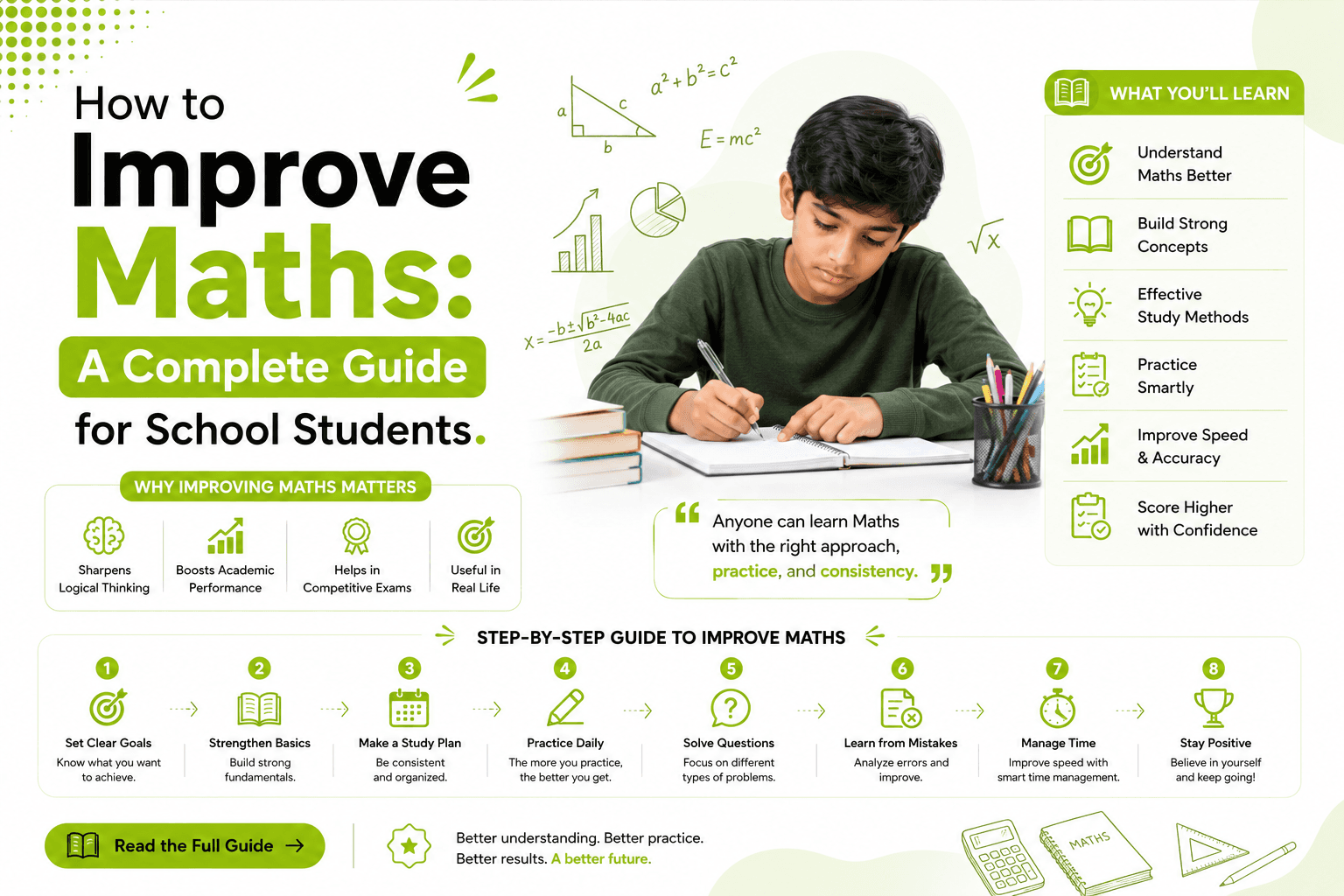
How to Improve Maths: A Complete Guide for School Students
Many students believe they are simply "bad at maths" when the real problem is often different. They may have missed an important concept, rely too heavily on memorising formulas, make the same calculation mistakes, or feel nervous whenever they see a difficult question.
The good news is that maths can be improved with the right approach. You do not need to be naturally gifted at mathematics to become better at it. Strong basics, regular practice, understanding mistakes, and learning how to approach problems step by step can make a significant difference.
If you are wondering how to improve maths, this complete guide explains practical strategies that school students can use to build stronger mathematical skills and confidence.
1. Strengthen Your Maths Basics First
Before trying to solve advanced questions, make sure your fundamentals are clear.
Mathematics is connected. New concepts often depend on earlier ones. If a student has difficulty with multiplication, fractions, decimals, or basic algebra, later topics can become much harder.
Start by checking whether you are comfortable with:
Basic arithmetic
Multiplication and division
Fractions and decimals
Percentages
Ratios and proportions
Basic algebra
Simple geometry concepts
If you discover a weak area, do not simply move past it. Spend time rebuilding that foundation.
A strong basic understanding can make more advanced chapters easier to approach.
2. Understand the Concept Instead of Memorising Everything
One of the biggest mistakes students make is trying to memorise every formula without understanding how or why it works.
Memorisation has its place in mathematics, but understanding should come first.
For example, instead of only memorising a formula, ask:
What does this formula represent?
Why does it work?
When should I use it?
Can I explain it in my own words?
When you understand the logic behind a concept, you are more likely to remember it and apply it correctly to unfamiliar questions.
3. Practise Maths Regularly
Maths is a skill. Like other skills, it improves through consistent practice.
Studying mathematics for several hours once a week is usually less useful than practising regularly.
Even a focused daily session can help you maintain familiarity with mathematical concepts.
A simple routine could be:
20 minutes: Review a concept
20 minutes: Solve practice questions
10 minutes: Check mistakes and revise
The exact duration can vary according to the student's age, workload, and academic level.
The important thing is consistency.
4. Do Not Skip Questions You Find Difficult
When students see a difficult maths question, their first reaction may be to look at the answer or skip it.
Doing this repeatedly can prevent real improvement.
Instead, try to understand where you became stuck.
Ask yourself:
Did I understand what the question was asking?
Do I know which formula or method to use?
Did I make a calculation error?
Am I missing a basic concept?
Did I misread the information?
If you can identify the exact problem, you can work on it.
A difficult question is not just a test of your knowledge. It can also show you what you need to learn next.
5. Learn From Your Mistakes
Checking the final answer is not enough.
Suppose you solve 10 questions and get three wrong. Do not simply mark them incorrect and move on.
Go back and analyse each mistake.
Create a simple mistake log with three columns:
| Question | Mistake | Correct Approach |
|---|---|---|
| Q1 | Wrong operation | Identify the required operation first |
| Q2 | Formula used incorrectly | Review when the formula applies |
| Q3 | Calculation error | Recheck each step |
Over time, you may notice patterns.
If you repeatedly make the same type of mistake, that is a sign that the underlying skill needs more practice.
6. Show Your Working Step by Step
Trying to solve everything mentally can lead to unnecessary mistakes, particularly in longer problems.
Write down the important steps.
For example:
Given information → Formula → Substitution → Calculation → Final answer
Showing your work makes it easier to identify where something went wrong.
It also helps you organise your thinking when solving multi-step problems.
As you become more confident, some calculations may become easier to do mentally. But developing the habit of structured working is particularly valuable while learning.
7. Practise Different Types of Questions
Solving the same type of question repeatedly can create a false sense of confidence.
You may know the method because the questions look familiar, but struggle when the wording changes.
After learning a concept, practise different question formats.
For example, after learning percentages, work on:
Finding a percentage of a number
Percentage increase
Percentage decrease
Word problems
Real-life applications
This helps you learn how to recognise when and where to apply a mathematical concept.
8. Improve Your Problem-Solving Skills
Maths is not only about calculations.
Many school questions require students to understand information, identify relationships, choose an appropriate method, and work through multiple steps.
When facing a word problem, try this process:
Step 1: Read the question carefully
Do not rush to calculate.
Step 2: Identify what is given
Write down the important information.
Step 3: Identify what you need to find
Be clear about the final question.
Step 4: Choose a suitable method
Decide which concept, formula, or operation is relevant.
Step 5: Solve step by step
Keep your working organised.
Step 6: Check the answer
Ask whether the answer makes sense.
This approach can be especially useful for students who know mathematical concepts but struggle to apply them.
9. Ask for Help When You Are Stuck
There is nothing wrong with asking for help.
In fact, waiting too long can make a small learning gap much bigger.
If you have tried a question several times and still do not understand it, ask a teacher, parent, tutor, or another trusted learning resource.
When asking for help, avoid simply saying:
"I don't understand maths."
Instead, explain exactly where you are stuck:
"I understand how to find the area, but I don't know why this formula is being used here."
A specific question usually leads to a more useful explanation.
10. Build Confidence Through Small Progress
Confidence in mathematics often develops through understanding and successful practice.
If a student constantly works on questions far above their current level, repeated failure can make them believe they cannot learn maths.
A better approach is to gradually increase difficulty.
Try:
Basic questions → Intermediate questions → Challenging questions
Mastering easier problems first can strengthen the foundation needed for more difficult ones.
Do not compare your progress with another student's.
Focus on whether you understand more today than you did before.
What Should You Do If You Are Still Struggling With Maths?
If a student is practising regularly but continues to struggle with the same concepts, the problem may not be a lack of effort.
There may be a learning gap somewhere in the foundation.
For example, a student struggling with algebra may actually have difficulty with fractions or basic arithmetic. In that situation, repeatedly practising advanced algebra questions may not address the real issue.
The first step is to identify where the difficulty begins.
Once the learning gap is understood, support can focus on rebuilding the necessary concepts rather than simply giving the student more questions.
A Simple Daily Maths Improvement Plan
Students looking for a practical routine can try:
10 minutes — Review:
Revise formulas, concepts, or previous mistakes.
20 minutes — Practice:
Solve questions related to the current topic.
10 minutes — Challenge:
Attempt one or two questions that require deeper thinking.
10 minutes — Mistake review:
Check your answers and understand your errors.
This does not need to be followed exactly every day. The purpose is to create a consistent learning habit.
How Can Parents Help a Child Improve in Maths?
Parents do not need to be mathematics experts to support their child.
They can help by:
Asking what the child is currently learning.
Encouraging questions instead of criticising mistakes.
Helping establish a regular study routine.
Reviewing progress rather than focusing only on marks.
Encouraging the child to explain how they solved a problem.
Looking for persistent learning gaps.
Avoid comparing your child with siblings or classmates. Comparisons can increase anxiety without addressing the actual learning difficulty.
If a child consistently struggles despite effort, personalised academic support may be worth considering.
RemedialOne's personalised learning approach can provide an option for students who need individual academic attention and support tailored to their learning needs.
Frequently Asked Questions
How can I improve my maths skills quickly?
There is no single shortcut. Consistent practice, strong fundamentals, understanding concepts, reviewing mistakes, and gradually increasing question difficulty are practical ways to improve maths skills.
How many hours should a student practise maths?
The ideal amount depends on the student's age, grade level, goals, and current understanding. Focused and consistent practice is generally more useful than simply studying for long hours.
Why do I understand maths in class but make mistakes in tests?
This can happen when students understand the basic concept but struggle to apply it independently under test conditions. Practising different question formats and reviewing mistakes can help.
What should I do if I cannot understand a maths chapter?
First identify the exact concept causing difficulty. Review the prerequisite basics, work through simpler examples, and ask for help if the difficulty continues.
Can one-to-one tutoring help improve maths?
One-to-one tutoring can provide individual attention and allow a tutor to focus on specific learning gaps, mistakes, and areas where a student needs additional practice.
Conclusion
Improving maths is not about being naturally talented. It is about building the right foundation, understanding concepts, practising consistently, learning from mistakes, and developing better problem-solving habits.
If you are trying to improve maths, start with the basics and work upward. Do not be afraid of difficult questions, and do not treat mistakes as proof that you cannot learn. Use them to identify what needs more attention.
For students who continue to struggle despite regular effort, personalised academic support can help identify learning gaps and provide more focused guidance.
The goal is not simply to get more questions right. It is to understand mathematics well enough to solve problems independently and approach the subject with greater confidence.