
How to Stop Procrastinating While Studying: 10 Tips
Satyam Kumar Singh From Remedial-one Educational desk.
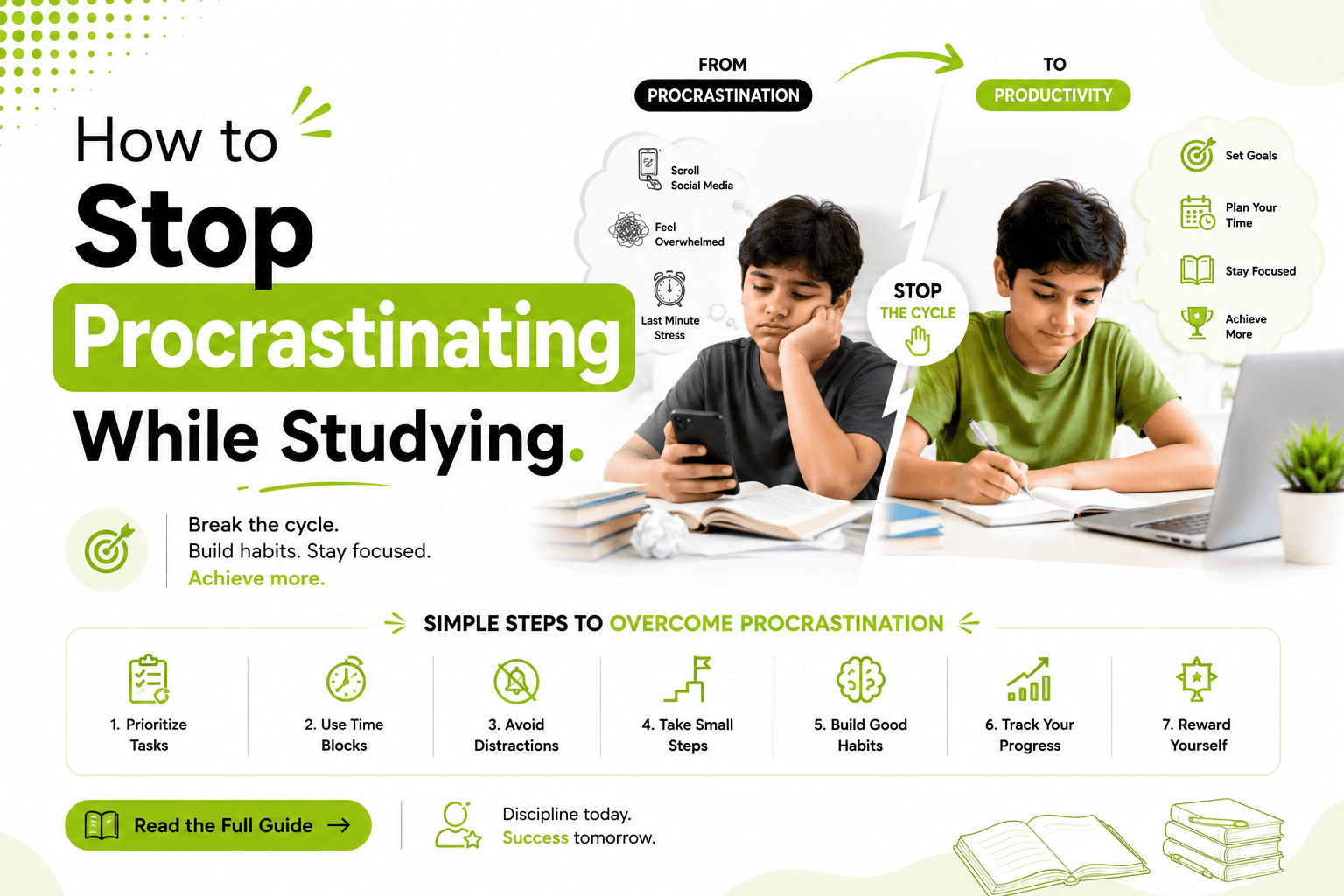
How to Stop Procrastinating While Studying
You sit down to study, open your book, check your phone for a minute, watch a short video, reply to a message—and suddenly half an hour is gone. You know you need to study, but starting feels harder than it should.
This is procrastination while studying, and it is a common problem among students. The solution is not simply to "work harder." In many cases, students procrastinate because a task feels difficult, boring, overwhelming, unclear, or too large to start.
The good news is that procrastination can be managed with practical changes to your study routine.
Here are 10 effective ways to stop procrastinating while studying and make it easier to start, focus, and finish your work.
1. Start With a Very Small Task
One of the biggest mistakes students make is creating a huge study goal.
For example, "I will study mathematics for three hours" can feel overwhelming. Your brain may respond by looking for something easier to do.
Instead, make the first task extremely specific:
Read two pages.
Solve five questions.
Review one topic.
Write one paragraph.
Revise one formula set.
The objective is to start, not to finish everything immediately.
Once you begin, continuing often becomes easier because the task no longer feels like an abstract, overwhelming responsibility.
2. Create a Realistic Study Plan
A study plan can reduce procrastination because it removes the question, "What should I study now?"
Instead of writing:
Study Science
write:
5:00–5:30 PM — Revise photosynthesis
5:30–5:40 PM — Break
5:40–6:10 PM — Solve practice questions
Specific tasks are easier to understand and act on.
However, avoid filling every minute of your day with study sessions. A plan that is too demanding can become another reason to procrastinate.
Make your schedule realistic enough to follow consistently.
3. Use the 5-Minute Starting Rule
If you are struggling to begin, tell yourself:
"I only need to study for five minutes."
Set a timer and start the task.
During those five minutes, do not worry about completing the chapter or finishing the assignment. Concentrate only on getting started.
After five minutes, you can decide whether to continue. In many cases, once the initial resistance disappears, continuing feels much easier.
This technique is particularly useful when the hardest part of studying is not the work itself but getting started.
4. Keep Your Phone Away While Studying
Your phone can make procrastination extremely easy.
A notification, social media message, short video, or game can quickly interrupt your concentration.
If you are studying, create distance between yourself and your phone.
You can:
Put it in another room.
Turn on Do Not Disturb.
Disable unnecessary notifications.
Keep social media closed.
Use your phone only when it is genuinely required for learning.
The less effort required to access distractions, the easier it is to give in to them.
Do not rely entirely on willpower. Change your environment so that focusing becomes easier.
5. Break Large Assignments Into Smaller Steps
A large assignment can create a feeling of "Where do I even begin?"
For example, instead of writing:
Complete history project
break it into:
Choose the topic.
Collect the required information.
Create an outline.
Write the introduction.
Complete the main sections.
Review and correct the work.
Each step feels more manageable.
This approach is especially helpful when students procrastinate because they feel overwhelmed by the size of a task.
A large goal becomes easier when it is converted into a series of small actions.
6. Try Focused Study Sessions
Studying continuously for several hours does not necessarily mean you are learning effectively.
Try working in focused sessions.
For example:
25 minutes study + 5 minutes break
or
40 minutes study + 10 minutes break
During the study period, focus on one task. During the break, step away from your books.
The exact timing does not need to be the same for everyone. Experiment and find a rhythm that allows you to maintain concentration without becoming mentally exhausted.
The key is to make your study sessions focused rather than unnecessarily long.
7. Find Out Why You Are Procrastinating
Not all procrastination has the same cause.
Ask yourself:
"What am I avoiding?"
You may be procrastinating because:
The subject feels difficult.
You do not understand the basics.
The assignment seems too large.
You are afraid of making mistakes.
You are tired.
You do not know how to start.
The work feels repetitive.
You are distracted by your environment.
Identifying the reason matters because different problems require different solutions.
If you do not understand a mathematics concept, spending another hour staring at the textbook may not solve the problem. You may need the concept explained differently or additional academic support.
8. Stop Waiting for Motivation
Many students think:
"I'll study when I feel motivated."
The problem is that motivation is not always present when you need it.
A better approach is to build a routine that allows you to begin even when you do not feel like studying.
Choose a regular study time, prepare your materials in advance, and start with a manageable task.
Over time, the routine can reduce the amount of decision-making required.
You do not have to feel motivated before every study session. Sometimes action comes before motivation.
9. Make Difficult Subjects Easier to Approach
Sometimes procrastination is actually a learning problem.
If you repeatedly avoid a particular subject, ask whether you are avoiding the subject because you find it difficult.
For example, a student may keep postponing mathematics because they have not fully understood an earlier topic. New chapters then become harder, creating even more avoidance.
In this situation, the solution may not be simply "study harder."
Try:
Revisiting the basic concept.
Asking specific questions.
Working through examples step by step.
Practising easier questions first.
Getting help when you remain stuck.
Personalised academic support can also be useful when a student has persistent learning gaps that make independent study difficult.
10. Reward Progress, Not Just Results
Students sometimes judge themselves only by their final marks.
But academic progress happens through smaller actions: starting homework on time, completing a study session, understanding a difficult concept, correcting mistakes, and finishing planned tasks.
Recognise these small achievements.
For example, after completing a focused study session, take a short break, listen to music, talk to a friend, or do another activity you enjoy.
The reward does not need to be large. It simply gives your brain a positive reason to associate focused study with completion rather than constant frustration.
What Should You Do When You Have Already Wasted a Lot of Time?
Do not spend another hour feeling guilty about the previous hour.
This is an important part of overcoming procrastination.
Students sometimes think:
"I've already wasted the afternoon, so I'll start tomorrow."
That turns a small delay into an entire lost day.
Instead, reset immediately.
Ask:
"What is the smallest useful thing I can do right now?"
It might be reading one page, solving three questions, or reviewing one concept.
Starting late is still better than postponing the task again.
A Simple Anti-Procrastination Study Routine
If you do not know where to start, try this routine:
Step 1: Choose one subject.
Step 2: Select one specific task.
Step 3: Put your phone away.
Step 4: Set a 25–40 minute timer.
Step 5: Study only that task.
Step 6: Take a short break.
Step 7: Review what you completed.
Step 8: Decide on the next small task.
Repeat the process rather than trying to complete everything in one sitting.
The goal is to create a study habit that you can maintain consistently.
When Is Procrastination Actually a Sign That You Need Help?
Occasional procrastination is normal. But if a student repeatedly avoids studying because they cannot understand the material, feels overwhelmed by basic academic tasks, or continues falling behind despite genuine effort, there may be a deeper learning issue.
In such situations, parents and students should look beyond time management.
The student may benefit from identifying specific learning gaps and receiving personalised guidance. One-to-one academic support can give students an opportunity to ask questions freely, work at an appropriate pace, and focus on areas where they need additional help.
RemedialOne's personalised learning approach is one option for students who need more individual academic attention.
Frequently Asked Questions
Why do students procrastinate while studying?
Students may procrastinate because a task feels difficult, boring, overwhelming, unclear, or stressful. Distractions such as phones and social media can also make postponing work easier.
How can I stop procrastinating and start studying?
Start with a very small, specific task. Put distractions away, set a short timer, and focus only on beginning. Once you start, continuing often becomes easier.
Is using a study timetable helpful for procrastination?
Yes, a realistic timetable can make studying easier by telling you what to do and when to do it. Avoid creating an overly demanding schedule that is difficult to maintain.
How can I stop using my phone while studying?
Keep your phone away from your study area, turn off unnecessary notifications, and use Do Not Disturb when possible. Making distractions less accessible can reduce the temptation to check them.
What if I procrastinate because I don't understand the subject?
Identify the specific concept causing difficulty. Review the foundation, ask questions, practise simpler examples, or consider personalised academic support if the problem continues.
Conclusion
Learning how to stop procrastinating while studying is not about becoming productive every minute of the day. It is about making it easier to start, reducing unnecessary distractions, and breaking difficult work into manageable steps.
Start small. Make your study goals specific. Keep your phone away. Use focused study sessions and, most importantly, identify the real reason you are avoiding the work.
If procrastination continues because your child or student is struggling to understand the material, the solution may require more than better time management. Identifying learning gaps and providing personalised academic support can help make studying more manageable.
The aim is not simply to study for longer. It is to study with greater focus, understand the material, and gradually become a more independent learner.