
My Child Is Weak in Maths: What Should I Do?
Satyam Kumar Singh From Remedial-one Educational desk.
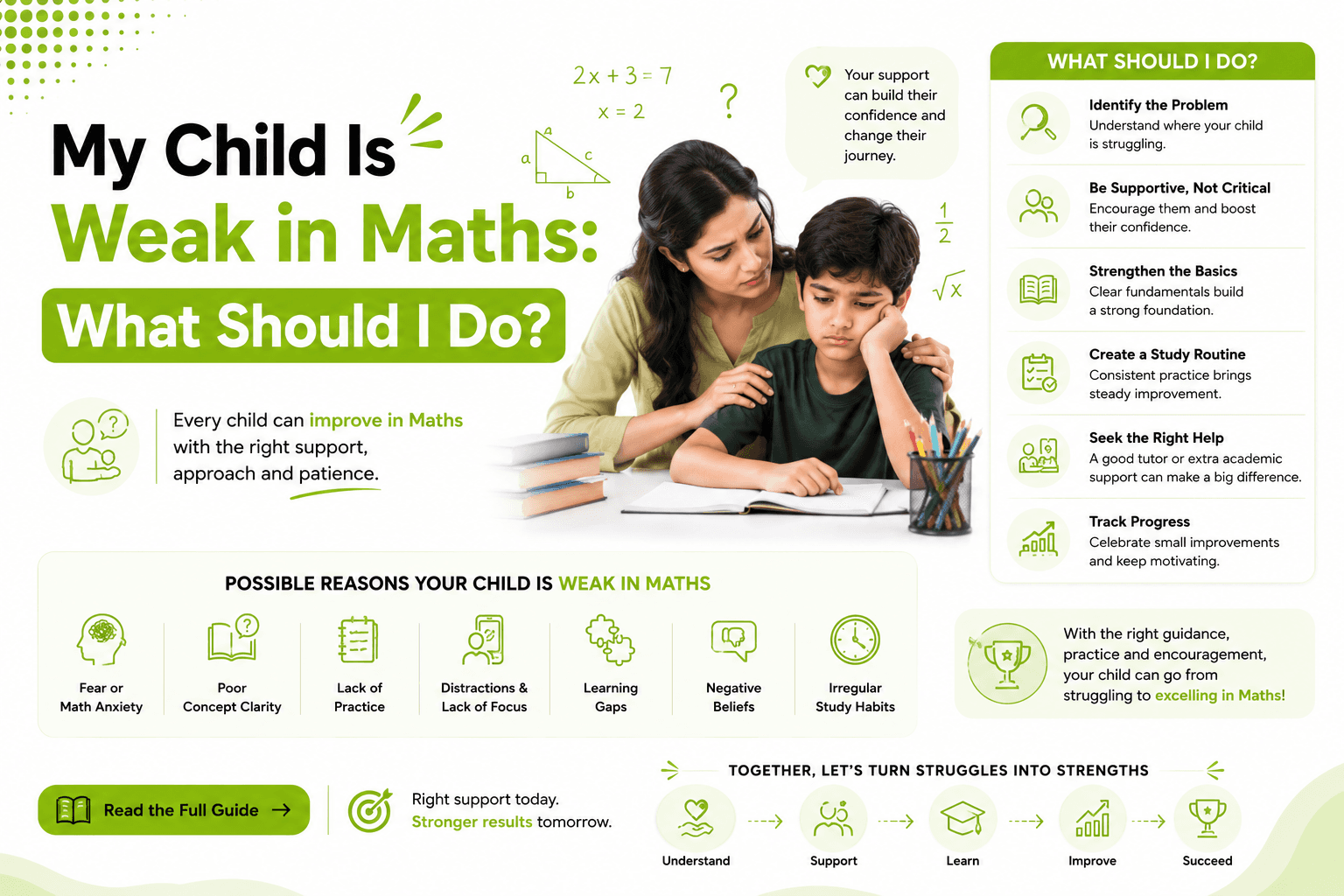
This is a common concern among parents. When a child regularly gets low marks, struggles with homework, or avoids maths questions, it can be difficult to know where to begin.
The good news is that being “weak in maths” does not have to be a permanent situation. In many cases, children struggle because some basic concepts were not understood properly, they have developed gaps in learning, or they have lost confidence after repeated mistakes.
Instead of putting more pressure on your child, the better approach is to understand the problem and provide the right kind of support.
Why Is My Child Weak in Maths?
Before trying to improve maths performance, parents should first understand what is causing the difficulty.
A child may struggle with maths because of:
Weak understanding of basic concepts
Gaps in previous classes
Difficulty remembering mathematical rules
Lack of regular practice
Trouble understanding word problems
Careless calculation mistakes
Fear of making mistakes
Low confidence
Difficulty concentrating during study
Learning at a pace that does not match their individual needs
For example, a child may appear weak in fractions because they are actually struggling with division. Similarly, difficulty with algebra may sometimes come from weak arithmetic or an incomplete understanding of mathematical operations.
This is why simply giving more questions to solve may not always help.
How Can I Find Out Where My Child Is Struggling?
Start by looking at your child's recent schoolwork, tests, homework, and class exercises.
Try to identify patterns.
Does your child:
Make the same type of mistake repeatedly?
Understand examples but struggle with new questions?
Know the formula but not know when to use it?
Make calculation errors despite understanding the concept?
Struggle to understand questions written in words?
Need someone to explain almost every question?
These observations can help you identify whether the main issue is conceptual understanding, practice, problem-solving, accuracy, or confidence.
The goal is not to label your child as weak. The goal is to identify the exact area that needs attention.
1. Strengthen the Basics First
Maths is a cumulative subject. New concepts often depend on skills learned earlier.
If the basics are weak, advanced topics can become increasingly difficult.
For example, a student may struggle with:
Fractions because division is unclear
Percentages because fractions and decimals are weak
Algebra because basic arithmetic is not secure
Geometry because mathematical vocabulary is confusing
Before moving quickly to difficult chapters, revisit the foundational skills your child needs.
You can also read our guide on How to Improve Maths: A Complete Guide for School Students for practical strategies that help students build stronger maths skills.
2. Focus on Understanding, Not Memorising
Many students try to memorise formulas and steps without understanding why they work.
This can create problems when they encounter a question that looks different from the examples in their textbook.
Encourage your child to ask:
“Why does this method work?”
For example, instead of simply memorising a formula, help them understand what each part of the formula represents and when it should be used.
Understanding makes it easier to apply knowledge to unfamiliar questions.
3. Practise Maths Regularly
A child who struggles with maths may need more practice, but that does not mean spending hours every day doing worksheets.
Short, consistent practice is often easier to maintain.
A simple routine could be:
15 minutes: Revise an old concept
20 minutes: Practise the current topic
10 minutes: Solve a few mixed questions
5 minutes: Review mistakes
The exact duration should depend on your child's age, school workload, and attention span.
Consistency matters more than completing a huge number of questions in one sitting.
4. Don't Let Mistakes Become a Source of Fear
Some children become anxious about maths because they have experienced repeated failure.
They may start thinking:
“I can't do maths.”
Once a child develops this belief, they may avoid difficult questions before even attempting them.
Instead of criticising mistakes, use them as learning opportunities.
Ask:
“Which step was difficult?”
“What did you try?”
“Can you find where the answer changed?”
“What could you try differently?”
This teaches your child that mistakes are part of learning rather than proof that they cannot learn maths.
5. Help Your Child With Word Problems
Word problems can be particularly challenging because they require both mathematical understanding and reading comprehension.
Teach your child to break the question into steps:
Read the question carefully.
Identify what information is given.
Identify what needs to be found.
Decide which operation or method is appropriate.
Solve step by step.
Check whether the answer makes sense.
This method can make complicated-looking questions more manageable.
6. Encourage Your Child to Show Every Step
Some students try to solve everything mentally.
While mental maths is useful, showing working can help identify where a mistake occurred.
Encourage your child to write:
The calculation
The formula, when needed
Intermediate steps
The final answer
This makes their thinking visible and makes it easier for both the student and parent to identify mistakes.
7. Stop Comparing Your Child With Other Students
Comparisons can create unnecessary pressure.
Avoid statements such as:
“Your friend is much better at maths.”
“Why can't you score like your cousin?”
“Everyone else understands this.”
Instead, compare your child's current progress with their own previous performance.
If your child previously struggled to solve five questions and can now solve eight independently, that is meaningful progress.
Confidence often grows when children can see their own improvement.
8. Make Maths Part of Everyday Life
Maths does not have to happen only with textbooks and worksheets.
You can naturally introduce maths through everyday activities.
For example:
Calculate shopping totals.
Compare prices.
Measure ingredients while cooking.
Work out travel time.
Discuss percentages and discounts.
Ask simple mental-maths questions.
Practical situations can help children understand that maths is a useful skill rather than simply a school subject.
9. Give Individual Attention When Necessary
Sometimes a child continues to struggle even after regular practice and parental support.
This may happen because the child needs concepts explained differently, more time to practise, or individual attention.
A classroom teacher has to work with many students, while one-to-one academic support can focus specifically on the student's learning gaps.
A personalised approach can help identify:
What the student already understands
Where the learning gap begins
Which concepts should be taught first
What type of practice is needed
Which mistakes keep recurring
This is the kind of individualised learning approach that RemedialOne focuses on through personalised one-to-one learning and academic support.
10. Create a Simple Maths Improvement Plan
Instead of trying to fix everything at once, create a weekly plan.
Monday
Revise one basic concept.
Tuesday
Practise questions based on that concept.
Wednesday
Work on a second weak area.
Thursday
Practise mixed questions.
Friday
Review mistakes from the week.
Weekend
Take a short practice test and identify what still needs attention.
The plan can be adjusted according to your child's school syllabus and current level.
If your child is in Class 6, our guide How to Get Better at Maths in Class 6 can also provide age-specific maths improvement strategies.
What If My Child Still Cannot Improve in Maths?
If your child has been practising consistently but continues to experience significant difficulty, do not simply increase the amount of homework.
Instead, step back and reassess.
Ask:
Is there a fundamental learning gap?
Does my child understand the concepts or only memorise procedures?
Are the questions too difficult for their current level?
Is confidence affecting performance?
Would individual academic support be useful?
Talking to the child's teacher can also help you understand what they are observing in the classroom.
The objective should be to find the right support rather than putting more pressure on the child.
Frequently Asked Questions
Can a child who is weak in maths become good at maths?
Yes. A child's current performance does not necessarily determine their future ability. With stronger foundations, regular practice, appropriate support, and confidence-building, many students can make meaningful progress.
How much maths should my child practise every day?
There is no single number that works for every child. Short, focused sessions are often more manageable than very long study periods. The routine should match the child's age, level, and school workload.
Should I hire a maths tutor for my child?
If your child needs help identifying learning gaps, understanding difficult concepts, or receiving individual attention, tutoring can be useful. The important thing is that the support addresses the child's actual needs.
Should I punish my child for getting low maths marks?
Punishment is unlikely to address the underlying learning gap. A better approach is to understand what went wrong, identify the concepts that need attention, and create a manageable improvement plan.
What is the first thing I should do if my child is weak in maths?
Start by identifying the specific concepts your child struggles with. Once you know where the difficulty begins, you can work systematically from the basics toward more advanced topics.
Conclusion
If your child is weak in maths, the first step is not to increase pressure. It is to understand why they are struggling.
Identify the learning gaps, strengthen the basics, practise regularly, review mistakes, and build confidence through achievable goals. When necessary, provide individualised academic support that matches your child's learning needs.
Most importantly, avoid turning maths into a source of fear. With patience, the right strategy, and consistent support, a child can gradually move from “I can't do maths” to “I can figure this out.”