
Remedial Education vs Regular Tuition: What's the Difference?
Satyam Kumar Singh From Remedial-one Educational desk.
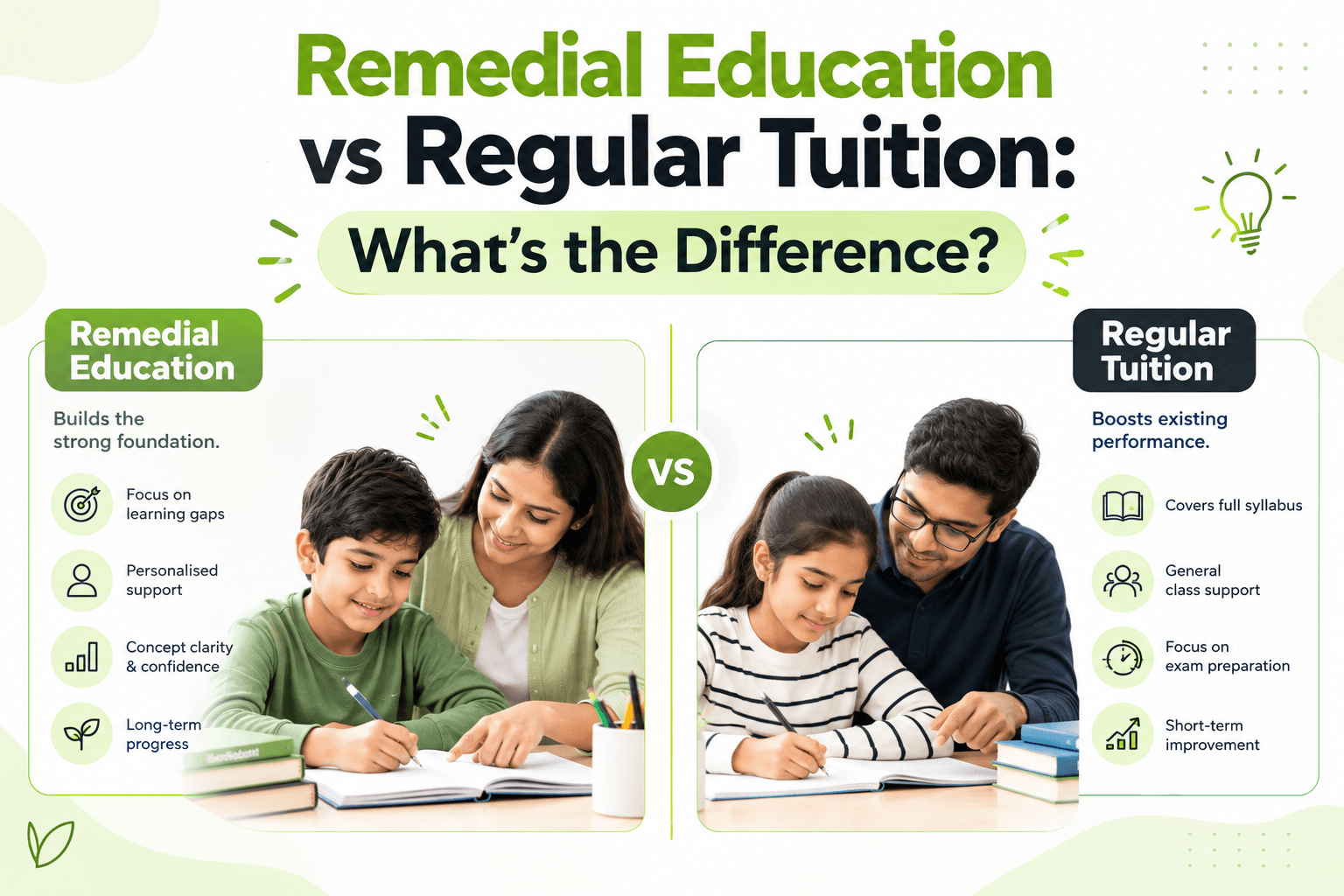
Remedial Education vs Regular Tuition: What's the Difference?
When a child struggles academically, parents often look for extra tuition. But not every student who needs academic support needs the same type of help.
Some students need help keeping up with their current school syllabus, completing homework, and preparing for tests. Others may be struggling because they have unresolved learning gaps from previous classes or topics.
This is where the difference between regular tuition and remedial education becomes important.
Regular tuition generally supports a student's ongoing school learning. Remedial education, on the other hand, focuses more specifically on identifying and addressing areas where a student has not developed the expected understanding or skills.
Neither approach is automatically better for every child. The right choice depends on why the child is struggling and what kind of support they need.
What Is Regular Tuition?
Regular tuition is additional academic instruction provided outside the normal classroom environment.
A tutor may help the student:
Understand current school lessons
Complete homework
Practise textbook questions
Prepare for tests and examinations
Revise chapters
Stay up to date with the school syllabus
Improve subject-specific performance
For example, if a Class 8 student is learning linear equations at school, regular tuition may provide additional explanations and practice on linear equations.
The primary focus is often on helping the student keep up with the current curriculum.
Regular tuition can be particularly useful for students who understand most of their schoolwork but benefit from additional practice, explanation, or supervision.

What Is Remedial Education?
Remedial education is a more targeted approach to academic support.
Its purpose is to identify specific areas of weakness or missing foundational knowledge and work on them systematically.
For example, a student may currently be studying percentages but still struggle with fractions and decimals.
Simply giving the student more percentage questions may not solve the underlying problem.
Remedial education may first address the relevant fraction and decimal concepts before returning to percentages.
The focus is therefore not just:
“What chapter is the school teaching?”
It is also:
“What does this student actually understand, and where does the gap begin?”

Why Is the Difference Important?
Imagine two students who both score poorly in mathematics.
Student A
Student A understands the concepts taught in class but does not practise enough. They make occasional calculation mistakes and need more question-solving practice.
Regular tuition may be sufficient.
Student B
Student B struggles with the current chapter because several foundational concepts from previous classes were never properly understood.
Giving Student B more questions from the current chapter may simply create more frustration.
A remedial approach may be more appropriate because the student first needs to strengthen the missing foundation.
The important point is that the same low mark can have very different causes.
Remedial Education vs Regular Tuition: Key Differences
| Area | Regular Tuition | Remedial Education |
|---|---|---|
| Main purpose | Support current school learning | Address specific learning gaps |
| Starting point | Current syllabus | Student's actual learning level |
| Focus | Current lessons, homework, exams | Missing concepts and foundational skills |
| Pace | Often follows school curriculum | Adjusted to student's needs |
| Assessment | May focus on tests and homework | Identifies specific areas of difficulty |
| Teaching approach | Additional explanation and practice | Targeted intervention and rebuilding |
| Best suited for | Students needing extra academic practice | Students with persistent or significant gaps |
| Progress measure | Syllabus completion and performance | Conceptual understanding and skill development |
This does not mean that every tuition programme follows exactly the same structure or that every remedial programme works in exactly the same way. The actual approach depends on the teacher, student, subject, and learning needs.
When Is Regular Tuition a Good Choice?
Regular tuition can be helpful when your child:
Understands most concepts but needs more practice
Needs help completing schoolwork
Wants additional preparation for exams
Needs support with difficult current topics
Benefits from structured study time
Wants to improve consistency
Needs additional explanation outside school hours
For example, a student who understands fractions but needs more practice solving different question types may benefit from regular tuition.
The student does not necessarily need to go back several years in the curriculum. They may simply need more guided practice.
When Might Remedial Education Be More Appropriate?
Remedial education may be worth considering when a child:
Has significant gaps in foundational concepts
Continues making the same conceptual mistakes
Struggles with topics from previous classes
Cannot understand current lessons despite regular practice
Is far behind the expected academic level
Takes much longer than expected to complete basic work
Has lost confidence because of repeated academic difficulty
Needs instruction at a different pace
Understands examples but cannot apply concepts independently
For instance, a student may be in Class 7 but have mathematical skills closer to an earlier level in certain areas.
The goal should not be to label the student by a lower grade.
Instead, the objective is to identify the specific skills that need strengthening and then help the student progress toward the current level.
Does Remedial Education Mean Going Back to the Beginning?
Not necessarily.
This is a common misunderstanding.
Remedial education does not mean repeating an entire academic year or starting every subject from the first chapter.
A student may have a strong understanding of most topics but struggle with a few specific foundations.
For example:
Strong: Addition, subtraction, multiplication
Needs support: Fractions
Strong: Basic geometry
Needs revision: Word problems
A targeted approach can focus on the specific areas that require attention.
This makes remedial education more efficient than simply repeating everything.
How Does Remedial Education Usually Begin?
A useful remedial approach begins with understanding the student's current level.
This can involve reviewing:
Previous schoolwork
Test papers
Homework
Class exercises
Common mistakes
Foundational concepts
Ability to apply knowledge independently
The purpose is to answer:
What does the student know?
What does the student partially understand?
What does the student not understand yet?
Once these areas are clearer, learning can be organised around the student's needs.
Why Are Learning Gaps So Important?
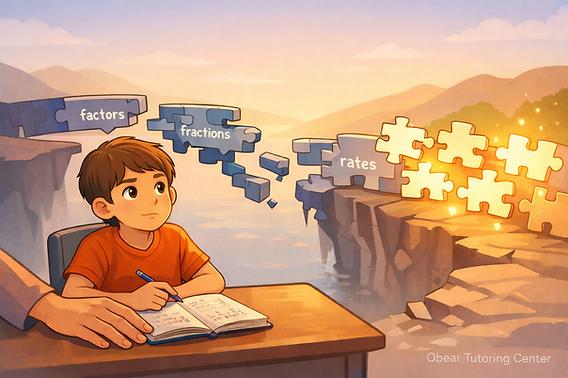
School subjects are often cumulative.
A new concept may depend on several earlier concepts.
Consider mathematics:
Basic operations → Fractions → Decimals → Percentages → Ratios → Algebra
If a student misses an important foundation, later topics may become progressively harder.
The same principle can apply to reading, writing, grammar, science, and other subjects.
This is why identifying a learning gap can sometimes be more useful than simply increasing the number of hours a child studies.
You can learn more about this in our article What Is a Learning Gap? How Parents Can Identify It.
Does Regular Tuition Fix Learning Gaps?
It can, depending on how the tuition is structured.
Regular tuition and remedial education are not completely separate categories.
A good tutor may notice that a student is struggling because of an older gap and decide to revisit the relevant foundation.
However, if the tuition programme is designed primarily around completing the current syllabus, there may be limited time to systematically address older gaps.
Parents should therefore ask:
Does the tutor assess the student's current level?
Will they identify foundational weaknesses?
Can they adjust the pace?
Will they revisit earlier concepts when necessary?
How will progress be measured?
The answers can help you determine whether the support is appropriate.
What About One-to-One Learning?
One-to-one learning can be useful in both regular tuition and remedial education.
The major advantage is that the learning process can be more closely adapted to the individual student.
A tutor can potentially:
Spend more time on difficult concepts
Move faster through areas the student already understands
Observe recurring mistakes
Ask questions to check understanding
Adjust the difficulty of practice
Provide immediate feedback
Build a personalised learning sequence
This can be particularly relevant for students with learning gaps because their needs may not match the pace of the classroom.
RemedialOne focuses on personalised one-to-one learning, remedial support, and mentorship, with attention to the individual student's academic needs rather than treating every learner exactly the same.
How Can Parents Decide Which One Their Child Needs?
Start with the problem, not the service.
Ask yourself:
Question 1: Does my child understand the current syllabus?
If yes, regular tuition may be enough for additional practice or exam preparation.
Question 2: Does my child struggle because of earlier concepts?
If yes, remedial support may be more appropriate.
Question 3: Does my child repeatedly make the same mistakes?
If yes, investigate whether there is a conceptual gap.
Question 4: Can my child solve a new question independently?
If not, they may need deeper understanding rather than simply more repetition.
Question 5: Is my child significantly behind the expected level?
If so, targeted academic assessment and individual support may be useful.
What Should Parents Look for in a Remedial Education Programme?
If you are considering remedial support, do not choose a programme simply because it uses the word “remedial.”
Ask how the programme actually works.
Look for an approach that:
Identifies specific learning gaps
Understands the student's current level
Uses an individualised learning plan
Builds foundational concepts
Uses appropriate practice
Tracks progress
Adjusts teaching when needed
Encourages independent learning
A programme should focus on helping the student become more capable, not permanently dependent on tutoring.
What Should Parents Look for in Regular Tuition?
If regular tuition is more appropriate, consider whether the tutor:
Understands the school curriculum
Explains concepts clearly
Provides appropriate practice
Reviews mistakes
Helps with exam preparation
Encourages questions
Monitors progress
Keeps the student engaged
The quality of teaching matters more than simply increasing the number of classes.
Can a Child Need Both?
Yes.
A student may need remedial support for foundational gaps while also needing help with the current school syllabus.
For example, a student could spend part of their learning time strengthening fractions while also keeping up with the current mathematics chapter.
The balance should depend on the student's needs.
A useful principle is:
Fix the foundation while continuing to move forward.
Completely ignoring the current syllabus may create another gap, while ignoring the old gap may make the current syllabus increasingly difficult.
What Should You Avoid When Choosing Academic Support?
Parents should be cautious about choosing support based only on promises such as:
Guaranteed marks
Guaranteed grade improvement
Extremely fast results
“No effort required”
Finishing the entire syllabus in an unrealistically short time
Academic progress is individual.
A more useful question is:
“How will this programme identify and address my child's specific learning needs?”
That question can reveal much more about the quality of the support.
How Do You Know If the Support Is Working?
Do not judge progress only by marks.
Look for signs such as:
The child can explain concepts more clearly
Fewer repeated mistakes occur
Homework becomes more manageable
The student needs less help with familiar concepts
They can solve unfamiliar questions
Confidence improves
The child becomes more willing to attempt difficult work
Foundational concepts become more secure
Marks can improve as understanding improves, but meaningful progress should also appear in the student's day-to-day learning behaviour.
Frequently Asked Questions
Is remedial education the same as tuition?
No. Regular tuition generally provides additional academic support alongside the school curriculum. Remedial education is more specifically focused on identifying and addressing learning gaps or areas of incomplete understanding.
Is remedial education only for weak students?
No. It is better to think of remedial education as targeted academic support. A student may be strong in some areas and still need remedial help in specific foundational concepts.
Can regular tuition help a child with learning gaps?
Yes, depending on how the tuition is structured. A tutor who identifies foundational weaknesses and adjusts teaching accordingly may address learning gaps. However, programmes designed specifically around remedial support may provide a more targeted approach.
Does remedial education mean my child has a learning disability?
No. A learning gap and a learning disability are not the same thing. Academic difficulties can have many causes. Persistent concerns should be discussed with the child's teacher or an appropriately qualified professional.
How long does remedial education take?
There is no standard timeline. It depends on the student's current level, the size of the learning gaps, the subjects involved, consistency of learning, and the type of support provided.
Which is better: remedial education or regular tuition?
Neither is universally better. The right choice depends on the child's needs. If the main issue is keeping up with current lessons, regular tuition may be suitable. If foundational gaps are preventing the child from understanding current work, targeted remedial support may be more appropriate.
Conclusion
The difference between regular tuition and remedial education comes down largely to the problem being addressed.
Regular tuition generally helps students learn, practise, and keep up with their current school curriculum.
Remedial education focuses more specifically on identifying learning gaps, strengthening foundations, and rebuilding the skills a student needs to progress.
Before choosing additional academic support, ask what your child actually needs.
Does your child need more practice?
More explanation?
Better exam preparation?
Or does your child have missing foundational concepts that are making current learning difficult?
Once you understand the real problem, choosing the right type of support becomes much easier.
The ultimate goal should not be simply to add more tuition hours. It should be to help the student understand better, learn more independently, regain confidence, and make sustainable academic progress.